

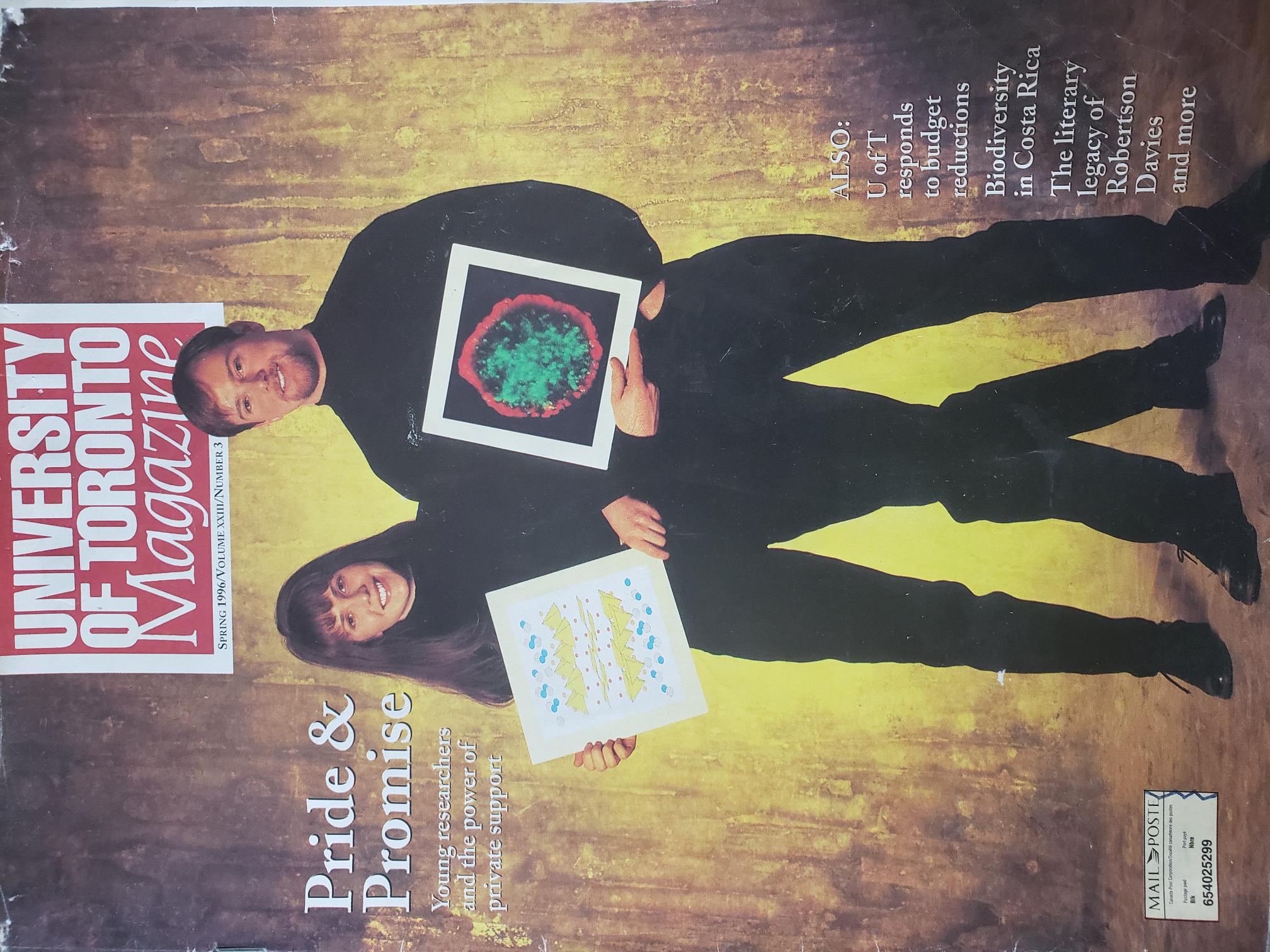
A “youthful and optimistic” Michael May (right) posing with a University of Toronto student
In pondering David Sinclair’s statement “Aging is far more reversible than we thought,” I couldn’t help but reflect on how much our field has changed since I was in grad school. Alas, looking back that far makes me feel really old!
My PhD in cell encapsulation focused on diabetes using porcine islets conformally coated in a novel synthetic polymer that isolated the islets from the immune system while inducing angiogenesis in the surrounding tissue. The latter property was driven by the recent discovery, at the time, of a multitude of growth factors by the laboratory of Judah Folkman. We called ourselves “tissue engineers,” but our approach relied mostly on replacing tissue, and that was hampered by the need for xenogeneic cell supplies, the concomitant issue of immune rejection, and managing cell viability in the absence of robust connectivity to the vasculature.
Tackling immortality heated up with research in developmental biology, the emergence of embryonic stem cells and Shinya Yamanaka’s Nobel prize-winning achievement in reprogramming adult cells into induced pluripotent stem cells (iPSCs). Not only did these pluripotent stem cells provide for a potentially unlimited supply of cells for tissue engineering, but incredible strides in controlling cell biology through reprogramming and subsequent differentiation made regeneration of tissue a possibility. Logically, our field re-positioned itself as “regenerative medicine”.
Our industry has evolved further, now settling on the term “cell and gene therapy,” as several products have been demonstrated effective in the clinic and most cell-based products in development integrate some form of genetic modification. Indeed, the transformative impact of gene editing, particularly CRISPR Cas-9, has helped sunset “the age of the stem cell” in favour of a new era: that of the “super cell”. Consequently, we see increased levels of investment in human longevity as these new tools are being used to modify the regenerative capacity of cells.
One of the pioneers of the industry throughout all of these “eras,” Michael West, has conducted research on biogerontology, stem cells, cellular aging and telomeres. He was CEO of Advanced Cell Technology, founder of Geron Corporation and is currently founder and CEO of AgeX Therapeutics (Note: I am on the Board of AgeX). One of the platforms under development at AgeX is iTR, which stands for induced tissue regeneration. It exploits the premise that cells transition from pluripotency to an adult (aging) state through a stage of regenerative capacity tied to certain genes being turned off or on. (Editor: If you are curious, Signals interviewed Michael West back in 2013. Read the three-part interview here, here and here.)
My youthful and optimistic self can’t help but dream of the possibilities….
The future CEO of CCRM is drinking her morning coffee (‘cause we know that caffeine slows aging) to the soft hum of Alexa downloading her biological data from the toilet and other analytical platforms in her home and sending the results to her AI-driven medical team. In real time, her “doctor” analyzes the performance of all of her organs against a target “due date,” recommending when she should visit the pharmacy of the future to receive a prescribed cocktail of cells, growth factors, small molecules, transcription factors or other advanced therapies (the newest name for our field) that she can pick up on her way to meditation and a workout at the local wellness clinic.
My aging and somewhat pessimistic self worries about this future. If we can reverse chronic disease, halt aging and replace malfunctioning tissue, then our future CEO will be drinking coffee when she wakes up because she stayed up all night drinking alcohol, eating fast food while sitting alone for hours in her virtual reality chamber, comforted by the fact that she can visit the pharmacy whenever she needs to reverse the damage caused by her poor lifestyle. Assuming she can afford it (I am assuming that CCRM salaries will be higher in the future), she will be able to purchase her youth and longevity whenever she wants.
I think that it is inevitable that we will be able to manipulate the aging process, adding decades onto our current lifespans. The extent and pace of scientific advancement in tissue engineering, regenerative medicine, cell and gene (and advanced) therapies, suggests that humans are on a trajectory to realize this level of control over our biology. I also agree with Yuval Noah Harari, the author of Sapiens, Homo Deus and 21 Lessons for the 21st Century, that humans are driven to be gods and that the pinnacle of this human aspiration will be the ability to live forever.
Thinking about all of this is making me tired. I need a nap to recuperate.
My blog is just one of many covering the topic of aging as part of Signal’s sixth annual blog carnival. Please click here to read what other bloggers think about this.

Michael May
Latest posts by Michael May (see all)
- 10 days ago in Toronto…. - August 22, 2023
- Thinking about longevity makes me feel old - August 25, 2021
- “It was the best of times, it was the worst of times….” - August 26, 2020


Comments