

 Today is International Women’s Day. This year, the theme is “think equal, build smart, and innovate for change,” to ensure that women’s needs and experiences are considered when it comes to innovation. While real progress has been made when it comes to gender equality, there is still much to be done to address the disadvantages, discrimination and barriers that women face today. In fact, the UN points out that based on current projections, existing efforts will fail to achieve a Planet 50-50 (i.e. where all women and girls have equal opportunities and rights) by 2030. This begs the question: Why does representation matter, especially for Canadian research, and what still needs to be addressed in order to achieve gender equality in science?
Earlier this week, the student group Women In Chemistry Toronto (WICTO) and six other co-sponsors hosted a panel on “Why Representation Matters in Canadian STEM research” at the University of Toronto, featuring four leading researchers advocating for equity, diversity and inclusion (EDI) in STEM. The panel discussed the need for representation, with references to the recent Lancet Women issue and the ongoing Athena SWAN consultations, as well as strategies for systemic change, including the discomfort in practicing EDI advocacy and the need to recognize EDI efforts as worthy of institutional recognition.
For a breakdown of the panel’s major takeaways, read on.
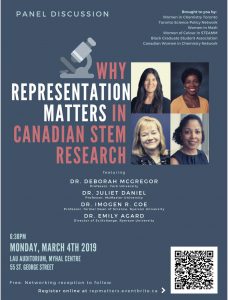
Photo credit: WICTO
The moderator, WICTO’s Mireille Ghossoub, began the panel discussion with the question of the night: Why does representation matter in Canadian STEM research? Dr. Imogen Coe (biochemistry professor and founding Dean of the Faculty of Science at Ryerson University) shared that “representation means seeing yourself reflected so that you can achieve goals and they can become more than just aspirations.” Fittingly, this year, the federal Department for Women and Gender Equality has chosen to focus on science for their annual celebration of International Women’s Day, and are leading a campaign to highlight the accomplishments of Canadian women & girls in STEM.
Dr. Emily Agard (associate professor at Ryerson University and director of SciXchange) commented on the value of different perspectives, stating that when you have representation, there are different voices to listen to and learn from and, as a result, you have a “more inclusive and respectable environment.”
During the event, panelists were asked about the landmark Lancet Women report. This is a 118-page issue published by the medical journal The Lancet in February 2019, providing peer-reviewed evidence for the institutional and systemic barriers impacting women’s experience and advancement in science, medicine, and global health. There are a number of key findings to note within this issue, including a review of organizational best practices towards gender equality in science authored by Coe and two additional researchers.
Coe said that the key take-away message of The Lancet Women issue is that advocating for EDI in science is “everyone’s responsibility” – and not just the individuals belonging to equity-seeking groups. Everyone can engage in EDI advocacy from their level in the academic hierarchy as an ally, sponsor or mentor.
Coe added that “it’s hard, hard work [to advocate for EDI]. There will be discomfort. Plan for that – expect for that.”
This discomfort was echoed by both Dr. Deborah McGregor (York University associate professor and Canada Research Chair in Indigenous Environmental Justice) and Dr. Juliet Daniel (associate professor at McMaster University) in responses throughout the night. In fact, McGregor pointed out that sometimes there’s a judgement call to make, as speaking up against micro-aggressions or inequitable practices has risks and can lead to blacklisting.
“Will I say this and never be invited back into this space again? Or will I say this and sleep tonight?” said McGregor, and recommended being “very strategic” on what micro-aggressions you call out, and to also have strategies in place to cope too.
In reference to discomfort, Daniel recounted her experience as being the only black professor at her institution for almost ten years. Instead of turning down student requests, Daniel joined committees and advocated through mentorship and writing recommendation letters to support several students. Daniel commented that we currently “value certain competencies” with accolades, but are not willing to acknowledge that EDI advocacy is worthy of the same recognition (e.g. as an activity worthy of reducing an academic’s teaching burden).
It is worth noting here that the three federal granting agencies are currently developing a made-in-Canada Athena SWAN framework to affect such systemic change. In the U.K., the Athena SWAN initiative was established in 2005 as a means of encouraging and recognizing institutional commitments to addressing gender inequality in academic fields. The proposed made-in-Canada Athena SWAN model will address not only gender inequality, but will also commit to addressing inequalities faced by all under-represented groups, including people of colour and people with disabilities.
With institutional recognition of EDI efforts, we’ll see more people engaging in advocacy rather than the usual faces from equity-seeking groups, said Coe, and referred to this phenomenon as the minority tax (i.e. the additional responsibility placed on equity-seeking individuals to represent their identity and advocate for EDI).
Other key topics during the night included science outreach, collaborating with indigenous communities and how to bring your whole self to your research.
In response to a question about evaluating the effectiveness of science outreach initiatives, Agard stated that “whenever we do an event, we open eyes and shatter stereotypes, we see [impact] right there,” but adds that it’s not just about diversity, but inclusivity too. How are we supporting women once they are in the system?
McGregor pointed out that if you are seeking to carry out research in collaboration with Indigenous communities, a legitimate question you may get is: how is your research going to help or give back to the community? Keep in mind that one approach will not work for all communities.
Perhaps the most memorable quote of the night came from Coe at the very end of the panel. In response to a student asking how they can bring both their identity and abilities to the lab bench, Coe stated that equity means excellence, and failing to incorporate equity is mediocrity. She implored attendees to “be human. Bring your humanity. Bring your tears. Bring your laughter. Bring your creativity. All those things make you a better scientist […] Be your fabulous, wonderful self. We need you.”

Latest posts by Farah Qaiser (see all)
- Scientists turned book authors: insights into the world of publishing - December 3, 2020
- First ever ComSciConGTA held virtually this fall - October 8, 2020
- Opportunities for professional growth in your science career in 2020 - January 16, 2020


Comments