

 Science doesn’t usually get a lot of attention during elections, and we think that this needs to change. That’s why, on August 8th, a coalition of science groups, including Evidence For Democracy, the Toronto Science Policy Network (TSPN) and the Science & Policy Exchange, launched a national non-partisan #VoteScience campaign to advocate for science during the upcoming federal election. In this blog post, I’ll walk you through some of the #VoteScience actions you can take this fall.
When it comes to science advocacy, it’s tough to know where to start. What are some actions you can take? Should you track down a candidate at an event, head directly to their office or, instead, simply send an email? And if you do secure a meeting, what are some issues you can discuss?
To help with this, the campaign organizers – of which I’m one – have assembled a #VoteScience portal with the tools you need to engage with candidates on science-based issues and the importance of evidence-informed decision-making.
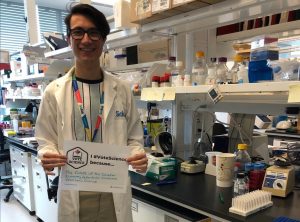
This #VoteScience selfie features Frank Telfer, a graduate student in the University of Toronto’s Medical Biophysics department. Credit: Jodi Lees.
For example, to advocate for science in the upcoming elections, you could:
- Send a letter to your candidates using this form. By filling in your postal code, our tool will send this letter to candidates in your riding, asking them to make science a key issue in their campaign.
- Take a #VoteScience selfie and tag in your candidates! Using this selfie template, you can share why you will #VoteScience this fall. Here are some examples in case you need inspiration. And if you’re wondering whether it’s worth posting a selfie, studies have shown that selfies humanize scientists, and challenge stereotypes.
- Meet with your candidates! Using our toolkit, you can prepare for a meeting with your candidate, whether it’s a one-on-one scheduled meeting or a surprise visit from your candidate in your neighbourhood. If you are a scientist and want to take it one step further, consider inviting candidates to visit your lab! Here’s how Amanda Veri creatively used one tweet and fungal cells to invite her MPP to visit her at work.
- Write an op-ed or fill out a #VoteScience postcard: Consider writing an op-ed in your local newspaper about why you’ll #VoteScience this fall. This may include sharing your research to highlight how federal funding supports science, or advocating for a specific issue. Alternatively, you can fill out a #VoteScience postcard to send to your candidates. These will be available in Toronto, Montréal and Ottawa soon.
- Join as a campaign supporter: If you belong to a science group, consider signing on as a #VoteScience campaign supporter – as CCRM did recently! There is minimal commitment required: you are simply encouraged to mobilize your members to take a #VoteScience action. Whether you’re a larger scientific society, a local organization or a student-led club, every group is critical when it comes to advocating for science this fall.
Overall, the #VoteScience campaign hopes to advocate for science in the upcoming elections – and we can’t do it without your help. If you have additional ideas, such as perhaps organizing a candidates’ roundtable, or a novel way to spread the word about the #VoteScience campaign locally, feel free to get in touch.
And if you’re interested in learning more or want to get involved in the #VoteScience campaign on a local level, be sure to check out the Let’s #VoteScience: Empowering Canadians to advocate for science event on Tuesday, August 27th. We’ve invited three panelists (Dr. David Naylor, Dr. Amanda Veri and Dr. Imogen R. Coe) who will be discussing science advocacy and some of the key science issues to consider this fall. Following the panel discussion, we’ll be filling out #VoteScience postcards to send to local candidates, so be sure to drop by!
If you missed Stacey Johnson’s post on this topic – “Science Matters. Stand up for science!” – you can read it here.

Check out the Let’s #VoteScience event if you’re interested in learning more about the campaign. Credit: Toronto Science Policy Network.

Latest posts by Farah Qaiser (see all)
- Scientists turned book authors: insights into the world of publishing - December 3, 2020
- First ever ComSciConGTA held virtually this fall - October 8, 2020
- Opportunities for professional growth in your science career in 2020 - January 16, 2020



Comments