

“Regenerative medicine news under the microscope” is a monthly feature highlighting big stories in stem cell research. I will sample the latest and greatest findings in recent press and package them into a single post.
This month, I cover an advance in the treatment of “butterfly” children, a new frontier in embryonic stem cell research, insights into stroke repair, and more!
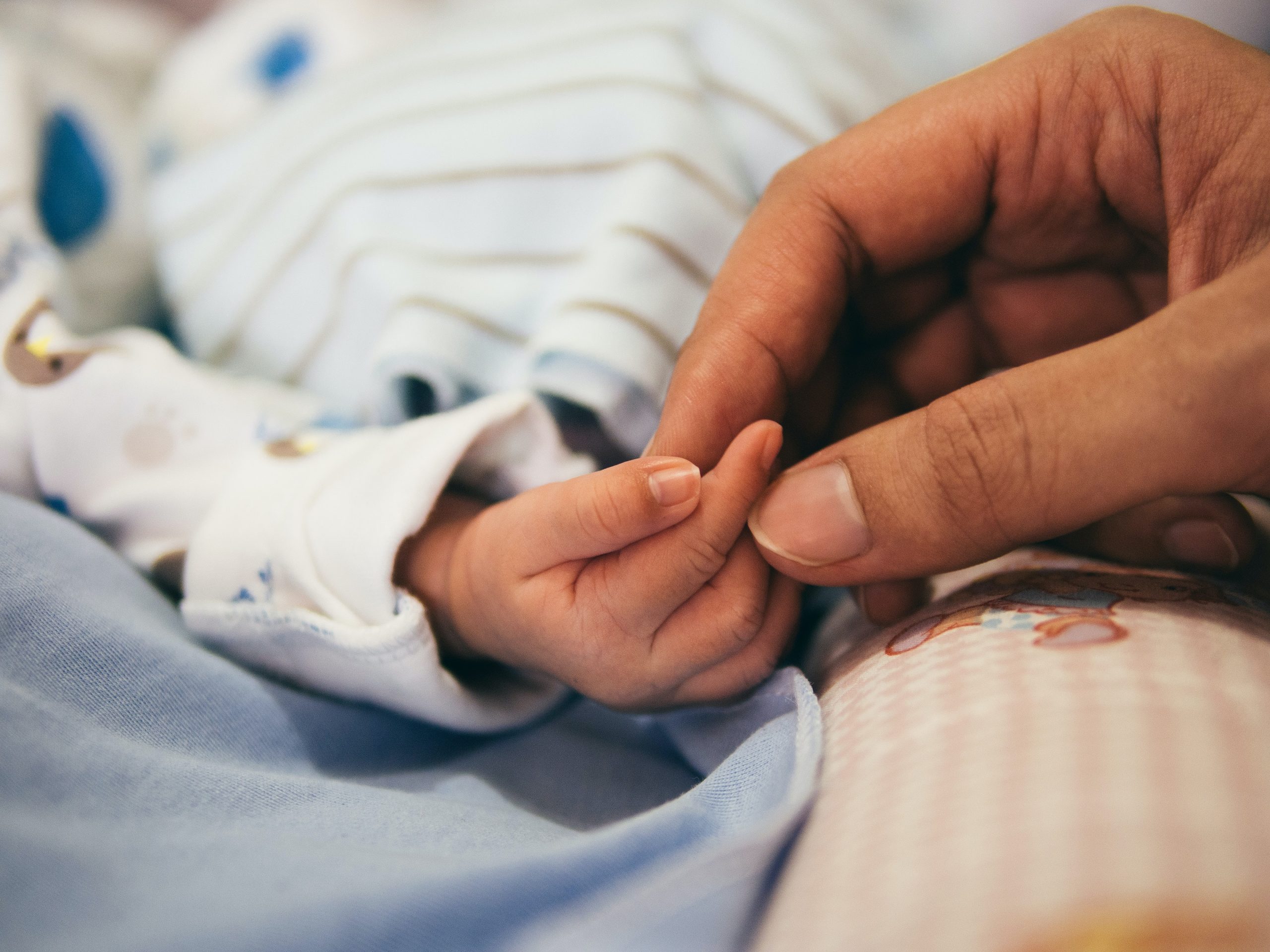
An adult touches a baby’s hand. Skin serves both as a barrier and means of connection. Credit: Aditya Romansa for Unsplash.
Pick of the Month
Hope for “butterfly children”: A new gene therapy
Your skin is the only thing standing between the rest of your body and the world. Many of us often take this critical organ for granted; however, there are those who do not have that luxury.
Epidermolysis bullosa (EB) is a group of rare, vicious genetic diseases that cause skin (and, in some cases, the lining of certain internal organs) to become fragile and blistered. This disease can also occur via spontaneous mutation, but such cases are even more rare. EB patients lack the proteins that keep the skin’s layers bound together. Thus the skin tears, blisters and can separate from the body far too easily. There is no cure, and there aren’t even treatments really – physicians just try to care for the wounds as best they can. In the most severe cases, life expectancy reaches a tragic maximum of 30 years, on average.
This month’s pick is an article reporting findings from Phase 1 and Phase 2 clinical trials that began in 2018. The treatment involves delivery of the healthy collagen VII gene, a protein patients lack. It was packaged into a safe, modified herpes simplex virus, which was loaded into a topical gel and applied to affected areas. Some of the patients’ wounds were healed in just three months, thanks to this new intervention. Read more at Science in a great piece by Jocelyn Kaiser, and check out the original Nature paper here.
(Ed: Signals has covered this topic many times in the past. If you’d like to read more blogs on epidermolysis bullosa treatments and Jonathan Pitre, the Canadian teen afflicted with this dreadful condition, click here.)
David Bennet, recipient of pig heart transplant, passes away at age 57
In my December 2021/January 2022 blog I wrote about David Bennet, a man with terminal heart disease who did not qualify for a human transplant. He was the first man in history to instead receive a pig heart. The organ wasn’t sourced from a regular pig, however: the animal had been genetically engineered to prevent organ rejection, the body’s destructive response to foreign tissue, and to keep the organ at a reasonable size.
We learned this month that Mr. Bennet passed away in hospital. A spokesperson for the University of Maryland Medical Center said that the cause of death is still unknown and that his physicians will publish their findings in a scientific journal. Read more here.
Turning back the clock on embryonic stem cells
In an international research effort involving researchers from China, the UK and Bangladesh, Mazid et al. have devised a method to revert human pluripotent stem cells to an earlier, totipotent state mimicking the “8-cell stage” in embryonic development. This represents a fertilized egg after just three rounds of division. Interestingly, the “two-cell stage” has already been captured in mice, but there was still lots to learn about this early stage of human development. Another interesting fact – the protocol doesn’t involve any transgenes.
The authors suggest that these findings will advance research on infertility, regular embryonic development and developmental disorders, epigenetics, lab-grown organs… the list goes on.
Getting BDNF past the blood brain barrier in HIV/neuroAIDS mice
NeuroAIDS is a grouping of neurological disorders brought on by HIV-induced damage to the peripheral and central nervous systems. Tragically, AIDS dementia, sensory neuropathy, and vacuolar myelopathy can result. Research has revealed a correlation between the severity of neuroAIDS and downregulation of BDNF, or brain derived neurotrophic factor, a critical molecule in a variety of brain functions. BDNF has also been implicated in other pathologies, including some related to age and psychiatric conditions. For further reading on the latter, check out work that’s been done on BDNF and depression, or BDNF and addiction (full-disclosure: the last paper is from my lab).
The goal of this study by Vitaliano et al. was to find a way to deliver BDNF to the brains of neuroAIDS mice, and more specifically, to the hippocampus. The authors accomplished this using intranasally-delivered nanoparticles to successfully transport BDNF to the brain. The treatment resulted in positive molecular and cellular changes that induced improvements in learning and memory deficits, which is undeniably good news for other groups investigating BDNF’s neurorestorative properties in other disease contexts.
A stroke of insight: Electricity, stem cells, and stroke
Globally the leading cause of long-term disability is stroke, which occurs when natural blood supply to a certain region of the brain is decreased or cut off. This deprives brain cells of oxygen and nutrients, starving neurons to death in just minutes. Functional deficits often follow as a result of the brain damage.
Stem cells have shown promise in the treatment of stroke, but the field had yet to define optimal parameters for this treatment. Enter Oh et al., who set out to address this by investigating the effects of electrical modulation on cell therapy. They developed a conductive polymer system that enables transplanted neural progenitor cells to electrically interact with their environment, and then used this system together with beneficial electrical stimulation to successfully kickstart repair. They found that the stimulation results in alterations to the transcriptome, revealing potential therapeutic targets for future investigation. Don’t miss this read.
Additional recommendations
Here are some papers/headlines that I didn’t have room for above:
Survival of an HLA-mismatched, bioengineered RPE implant in dry age-related macular degeneration. Kashani et al. in Stem Cell Reports.
Generation and characterization of hair-bearing skin organoids from human pluripotent stem cells. Lee et al. in Nature Protocols.
Müller glia fused with adult stem cells undergo neural differentiation in human retinal models. Bonilla-Pons et al. in eBioMedicine.
Genome-wide screening identifies Polycomb repressive complex 1.3 as an essential regulator of human naïve pluripotent cell reprogramming. Collier et al. in Science Advances.
Cx43 hemichannels contribute to astrocyte-mediated toxicity in sporadic and familial ALS. Almad et al. in PNAS.
PPARdelta activation induces metabolic and contractile maturation of human pluripotent stem-cell-derived cardiomyocytes. Wickramasinghe et al. in Cell Stem Cell.
Multi-modal profiling of human fetal liver hematopoietic stem cells reveals the molecular signature of engraftment. Vanuytsel et al. in Nature Communications.
Screening for modulators of the cellular composition of gut epithelia via organoid models of intestinal stem cell differentiation. Mead et al. in Nature Biomedical Engineering.
A single factor elicits multilineage reprogramming of astrocytes in the adult mouse striatum. Zhang et al. in PNAS.
A systematic review and meta-analysis of gene therapy with hematopoietic stem and progenitor cells for monogenic disorders. Tucci et al. in Nature Communications.
Reversing hearing loss with regenerative therapy. Zach Winn for MIT News.
DNA replication fork speed underlies cell fate changes and promotes reprogramming. Nakatani et al. in Nature Genetics.
Piezo1 regulates the regenerative capacity of skeletal muscles via orchestration of stem cell morphological states. Ma et al. in Science Advances.
50 influencers on stem cells on Twitter to follow in 2022. Dr. Paul Knoepfler for The Niche. Thanks for including us on your list, Dr. Knoepfler!
Microwell bag culture for large-scale production of homogeneous islet-like clusters. Suenaga et al. in Scientific Reports.
Functional, metabolic and transcriptional maturation of human pancreatic islets derived from stem cells. Balboa et al. in Nature Biotechnology.
Stay tuned for my next post, coming up in April!


Lyla El-Fayomi
Latest posts by Lyla El-Fayomi (see all)
- Optogenetic tools have officially changed the fight against blindness - June 24, 2026
- 2025 Recap: Regenerative Medicine News Under the Microscope - March 12, 2026
- Regenerative Medicine News Under the Microscope – Summer Edition, Part I - July 17, 2025


Comments