

One of the things that sets the Till & McCulloch Meetings (TMM) apart from other conferences, in my opinion, is the priority placed on trainee development. In part, the Stem Cell Network (SCN) achieves this through their support of the Trainee Communications Committee (TCC) which I had the privilege to serve on as Vice-Chair this year. The TCC organizes workshops and events at TMM and, in the first in-person edition of TMM since 2019, these sessions were attended by a total of 140 trainees.
What follows is my attempt at distilling over thirteen hours of TCC workshop programming into a non-exhaustive series of six tips I collected from expert panelists at these events. These tips cover a broad array of topics, and my hope is that some subset may be useful to the reader, regardless of trainee stage.
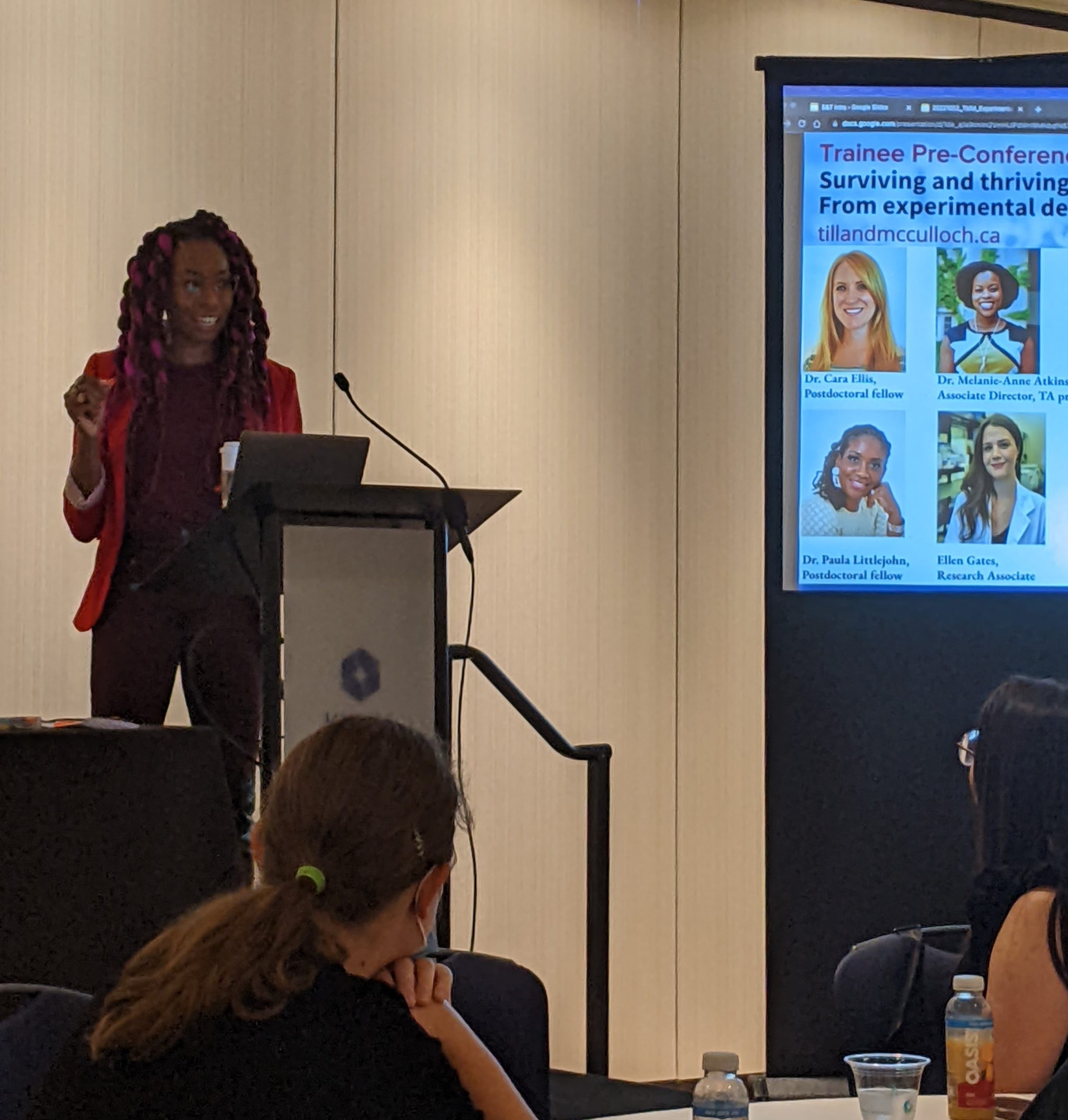
Priye Iworima (TCC Chair) during the “Surviving and thriving in graduate school” workshop
Pre-conference workshop #1: Surviving and thriving in graduate school: from experimental design to mental wellness
This two-part workshop provided a crash course on navigating graduate school, including practical tips on project planning as well as a panel discussion on mental wellness.
Tip 1: When interpreting data, replace certainty with curiosity.
Dr. Cara Ellis (University of Alberta) opened the workshop by pointing out that a feeling of certainty is an involuntary and unconscious phenomenon. When interpreting data, feelings of certainty can be problematic as they can present a barrier to seeking alternative explanations for an experimental observation. As an antidote, Dr. Ellis advised replacing this feeling of certainty with a sense of curiosity that will serve to strengthen one’s critical thinking skills and enable more accurate storytelling based on the data.
Tip 2: Dealing with stress, burnout, guilt and shame in graduate school.
During the panel discussion on mental wellness, the topic of stress came up a lot. While stress is never easy to deal with, the panel emphasized that taking breaks, scheduling time for self-care, and pursing interests unrelated to your research degree are all essential. Dr. Daniel Aguilar-Hidalgo (University of British Columbia) described that self-care (including exercise, showering, meditation, etc.) should not be confused with work-life balance; self-care represents a minimal requirement that can help to avoid burnout, but it is different from “having a life” outside of research. These comments led into a discussion on a sense of “guilt” that trainees may experience when taking breaks from their research. Nelson Szeto (Counselling & Consultation) aptly pointed out that in some cases, it may actually be shame (a sense that “I am bad”), rather than guilt (“I have done something bad”) that drives students to overwork. Use of accurate language may serve as a useful starting point to better understand and address this complex emotion.
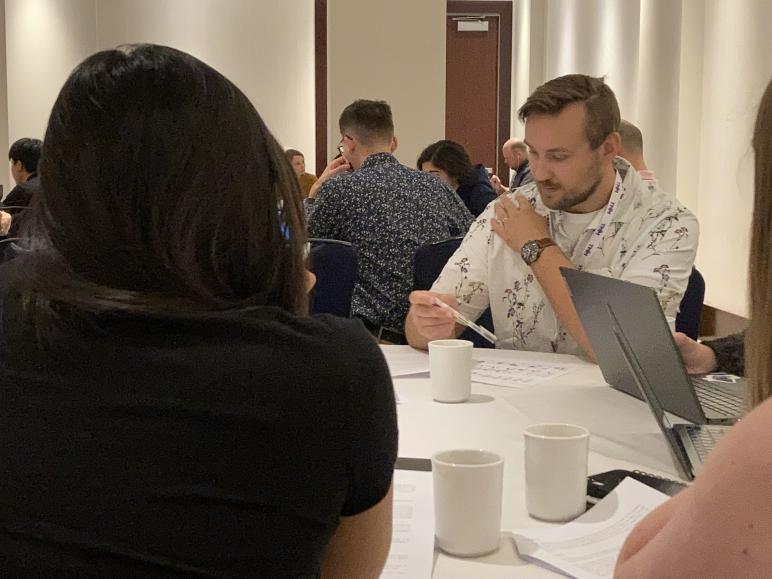
Trainees interact during a pre-conference workshop. Image credit: Tyler Wenzel
Pre-conference workshop #2: Leveling up on influence: Communicating your project to a broader audience and learning how to pitch scientific ideas to non-scientists
The Leveling Up workshop focused on honing verbal communication skills. Part 1 was on communicating research projects to non-scientists, and Part 2 featured a panel discussing key aspects of commercialization. The latter included a pitch competition with winners judged by the expert panel.
Tip 3: Narratives are a powerful tool for scientific storytelling.
When communicating your research to broad audiences (including the public), the SciCATS team of science communicators emphasized the use of storytelling as a tool to engage your audience. As a starting point, the team recommended use of an “And, But, Therefore” (ABT) statement to distill down your research’s key message using a fill-in-the blank method: [blank] AND [blank] use these blanks to provide context on the problem you are investigating; BUT [blank] the conflict; THEREFORE, [blank] describe the approach you’re using, or solution you are developing. As an example, here is an ABT statement on my own research: “Mesenchymal stromal cells are being explored as a therapy for osteoarthritis AND safety of these therapies have been demonstrated in clinical trials. BUT clinical efficacy has been variable due to heterogeneity of the cells. THEREFORE, I am developing criteria that could be used to assess different preparations of these cells and evaluate their relative therapeutic fitness prior to administration in osteoarthritis patients.”
Tip 4: How to create a funding pitch for a new biotech venture.
In the second part of the workshop, Allyson Tighe (Amplitude Ventures) shared her expertise on creating an effective pitch to finance a new life sciences venture. Things to highlight in a pitch include: the team, the science, clinical pathways, market information, competition, regulatory pathways, and finance projections. Tighe indicated that the science included in a pitch should generally cover the basic amount of data needed to showcase the technology or process, and demonstrate its novelty. Panelists in this portion of the workshop also emphasized that having the right team of people is critical for attracting investors, and that a pitch should have a very clear ask on the level of funding that is being requested.
ELSI Panel Discussion: Incorporating ethical, legal, and social implications to strengthen stem cell science and knowledge mobilization
The Ethical, Legal, and Social Implications (ELSI) Panel Discussion is an annual event at TMM, and this year’s session featured a case study that engaged participants to consider the importance of ELSI in experimental and clinical trial design, as well as in policy development.
Tip 5: ELSI can strengthen science.
In the opening remarks, Alexandra Kozlov (Western University) advocated that ELSI applies to all aspects of stem cell and regenerative medicine research from bench-to-bedside. To emphasize this point, expert panelists discussed a case study with participants that included examples from basic science, clinical trials, and policy categories where ELSI considerations were applied. Specifically, the case study included discussion on sex-based analyses in a drug screening experiment with human stem cells, creation of fair and appropriate eligibility criteria for a cell therapy clinical trial, and determining policy decisions around access and distribution to stem cell therapies.
Tip 6: Start incorporating sex-based analyses in your research.
Dr. Liisa Galea and Dr. Elizabeth Rideout (both University of British Columbia) discussed the importance of including sex as a biological variable in biomedical research. They pointed out that many studies do not include more than one sex, and many more fail to perform sex-based analysis. Better inclusion of biological sex as a variable in stem cell research could help identify which individuals may benefit from stem cell-based therapies, and which individuals to choose when isolating stem cells with desirable properties. Ultimately, sex-based analyses not only increase the impact of fundamental and preclinical studies, but they also carry important ethical implications when considering clinical translation of a potential therapy.
Outside of the workshops described above, trainees at TMM also had opportunities to network and receive personalized tips from research and industry leaders through the annual Meet the Experts Luncheon organized by the TCC and sponsored by OBIO, as well as the inaugural Career Connect event organized by SCN and sponsored by CCRM. If you have a burning idea for a future TMM training workshop, reach out to me or apply to join the TCC team.
Acknowledgments
The pre-conference workshops and ELSI Panel Discussion were supported by the Stem Cell Network. TCC members included: Priye Iworima (Chair), Dr. Rasha Al-Attar, Jules Granet, Kabita Baral, Alexandra Kozlov, Kieran Mahedan, Dr. Morten Ritso, Fereshteh Sadat, Laura Stankiewicz, Coulter Montague Szakaly, Dr. Tyler Wenzel, and myself.
Pre-conference workshop #1 included the following panelists: Dr. Cara Ellis, Dr. Melanie-Anne Atkins, Dr. Paula Littlejohn, Ellen Gates, Dr. Colin Francis, Dr. Daniel Aguilar-Hidalgo, Peter Overby, and Nelson Szeto. Pre-conference workshop #2 included the following panelists: Michael Unger, Armin Mortazavi, Koby Michaels, Dr. Irja Donaghue, Allyson Tighe, Roger Kuypers, Dr. Effie Christidi and Sheena Sibug. The ELSI Panel Discussion included the following panelists: Prof. Timothy Caulfield, Dr. Liisa Galea, Dr. Manoj Lalu, Prof. Amy Zarzeczny, Dr. Elizabeth Rideout, and Dr. Dean Fergusson.

Kevin Robb
Latest posts by Kevin Robb (see all)
- Mesenchymal stromal cell product joins FDA’s list of approved cell and gene therapies - May 22, 2025
- Lessons learned from market-approved mesenchymal stromal cell products - August 22, 2024
- A bench-to-bedside story of BlueRock’s investigational stem cell therapy for Parkinson’s disease - November 9, 2023


Comments