

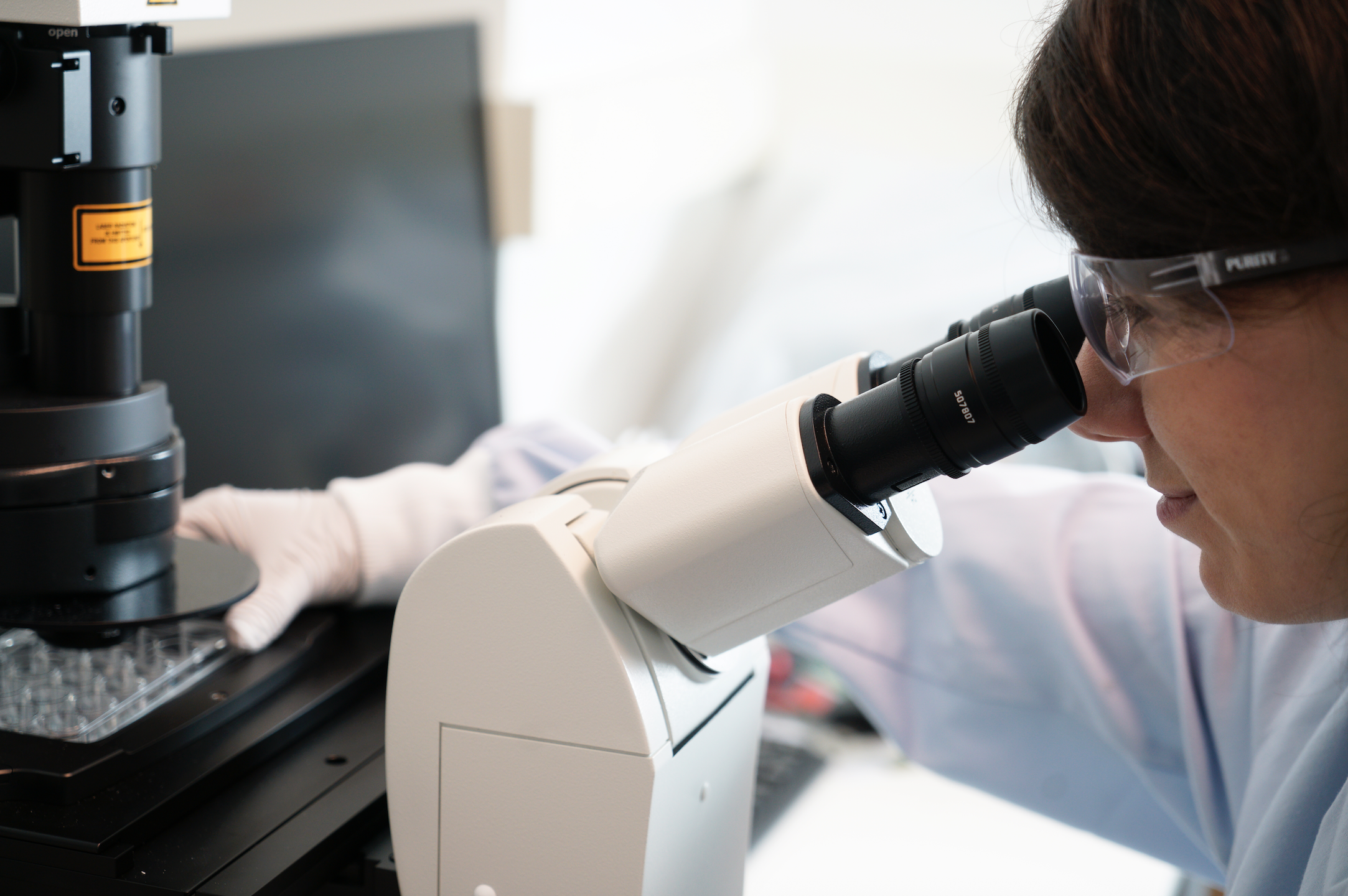
A CCRM scientist looking through a microscope
Somehow we are already into March, and spring – at least in some places – feels close by. To catch you up, I’ve put together a recap of some of the research that scientists were buzzing about in the field of regenerative medicine from 2025; I cover the good, the bad, and the controversial. All of these stories were first highlighted in Regenerative Medicine News Under the Microscope, so consider this a greatest-hits compilation. These investigations just continue to get bigger, and it’s very encouraging to think that we’re finally making some progress in bringing what could be game-changing treatments out of labs and to people who really need them.
Let’s jump right in! In no particular order:
- Parkinson’s disease
Specifically, work by Bluerock Therapeutics, which announced that their stem cell therapy for Parkinson’s would be moving to Phase III. It was found to be safe, and there are hints of potential efficacy, but we now get to find out how effective it really is with more patients trying out the treatment.
- Good news for epilepsy
Another stem cell therapy that jumped to Phase III this past year was Neurona Therapeutics’ solution for epileptic seizures that don’t really respond to medications. This one’s particularly interesting because we finally get to test theories that have been investigated in vitro and in animals for years. In its simplest form, the theory is that epilepsy is likely caused by an imbalance between the chemicals in the brain that amplify or increase electrical activity, and the chemicals that dial down or inhibit activity. It continues that epilepsy patients may not have enough of the dampening chemical, and there’s just too much runaway electricity. Neurona’s cell therapy introduces more cells into the brain that produce the inhibitory chemical, just to dial things down a bit, and again it was looking very promising in the Phase I/II trial.
- Vision repair
Optogenetics is one of my specialties, so stories like these are always particularly exciting to me. In 2025, there was a very elegant application of optogenetics for vision loss. Patients received a genetic therapy involving a lab-created, light-sensitive protein. I would so encourage our readers to go and watch the videos included in the published paper; it was really inspiring to see someone go from not being able to detect where a light is in a room to actually being able to walk straight towards it.
- Healing damaged corneas with one’s own stem cells
This story is really USA-specific. Researchers conducted a Phase I/II clinical trial of the first xenobiotic-free, serum-free, antibiotic-free manufacturing protocol developed in the U.S.
While this paper is exciting, I just wanted to highlight that using healthy limbal stem cells from one eye to heal a damaged cornea in the other is not new, and the authors don’t claim it to be so, yet the news on this story was largely making it out to be an entirely novel procedure; I thought this was interesting. In fact, we’ve been doing it here in Canada for a while. The actual novelty offered by this protocol is that manufacturing guidelines in the U.S. are different, and that’s what’s preventing autologous limbal stem cell transplants in their current form from being used by our Southern neighbours… until now, potentially. The researchers behind this paper modified various in vitro steps to adhere to the U.S. Food and Drug Administration’s (FDA) Good Manufacturing Practices, meaning this treatment might soon be accessible to patients in the U.S. – a great accomplishment.
- Stem cells for diabetes
Vertex Therapeutics, which also manufactures Casgevy – the gene-editing medicine for sickle cell disease – has also developed a cell therapy for severe type 1 diabetes, and there are people who have participated in their clinical trial who are now able to make their own insulin. The data was published in 2025.
Significant downside: Patients receiving this therapy also need to take immunosuppressants because the cell therapy comes from someone else. To get around this, Vertex was also working on a different version of this treatment where the transplanted cells could be encapsulated in a device that would protect them from the immune system. Unfortunately, it was announced last year that their device failed in a separate clinical trial so, for now, immunosuppression is the only option.
- Alzheimer’s disease
Longeveron published its Phase IIa CLEAR MIND trial with positive results, testing a mesenchymal stem cell (MSC) therapy for mild Alzheimer’s disease (AD). This was an intravenous treatment created using bone marrow-derived MSCs.
MSCs are being tested for many different diseases because they seem to be really adept at modulating the immune system and managing inflammation (and as you likely know, what disease these days doesn’t involve inflammation). Their goal was to slow the clinical progression of AD and, importantly, immunosuppressive drugs weren’t required in this trial despite the fact that the cells did come from donors. This is because MSCs are immunoprivileged, and they don’t trigger the immune system in the same way other cells might.
A Phase II/III trial is currently in development.
- A darker story about Duchenne Muscular Dystrophy
Duchenne muscular dystrophy (DMD) is a genetic disorder that causes muscle degeneration. You can imagine how that affects everything in the body: one’s ability to move, breathe, keep the heart beating properly, all of it. A company called Sarepta Therapeutics created a one-time genetic therapy for the disease, and a few deaths in 2025 revealed that it’s really not for everyone with DMD. Patients who were walking around on their own were able to take this medicine largely without major incidents. However, a pair of patients did die after taking this medicine, and it turns out they were non-ambulatory, meaning they couldn’t walk independently. The FDA took this information and decided to restrict use of this medication to only those who could walk, and walking here appears to be a readout of disease severity. Liver failure was the cause of death, a complication of viral gene delivery. The FDA also added a warning to the label for patients with pre-existing liver issues.
Fierce Pharma has a great piece on this story if you want to learn more.
- Onto more positive news: custom CRISPR medicines
Six months, one week, and four days.
That’s how long it took scientists to create a custom CRISPR therapy for baby KJ, who was suffering from a rare, life-threatening condition called CPS1 deficiency – short for carbamoyl phosphate synthetase I deficiency. This timeline is unprecedented, given that drug development usually takes over 10 years.
CPS1 deficiency is a genetic defect of the process by which the body metabolizes protein. What results is a buildup of ammonia in the tissue, which can be toxic (especially in the brain). Estimated to have an infant mortality rate of 50 per cent and affect just 1 in 1,300,000 people, even if the child does survive, there’s still a risk of developmental delays and intellectual disabilities.
Of course, once the baby is diagnosed, their protein consumption is often significantly restricted and nitrogen scavenging medication is usually prescribed. In KJ’s case, rather than the usual liver transplant that would follow, the research team of Musunuru et al. developed a custom CRISPR therapeutic to edit the infant’s genetic code.
To date, KJ has been stable and is consuming more protein and less medication, suggesting efficacy. However, longer follow-up will be required to assess the overall safety and determine just how well the treatment works. So far, so good!
Read more in this NIH news release.
- CAR T-cell therapy
As you likely know, CAR T-cell therapies available in clinics are currently ex vivo: T cells are removed from the body, upgraded in the lab, then returned to the patient.
Taking this strategy to the next level, researchers have been working on a way to upgrade T cells without removing them first. A very nice example of this was published by Hunter et al. Their team developed an in vivo genetic engineering strategy to reset the immune system and create CAR T cells in humanized mice and cynomolgus monkeys.
They use targeted lipid nanoparticles to deliver the mRNA to specific subsets of T cells.
Check out this great news piece in Nature Reviews Drug Discovery that summarizes progress in this space.
- Cancer vaccines!
This piece wouldn’t have been complete without mention of Anixa Biosciences’ breast cancer vaccine.
Phase I enrollment wrapped up in 2025. The vaccine is a set of three shots given two weeks apart. So far, 35 women have received the vaccine.
Preliminary results suggest that the vaccine is well-tolerated and that it does indeed mobilize an immune response, so Phase II is in the works.
- Aging
A single factor for safer cellular rejuvenation.
This paper left everyone in the scientific community very confused. A company called Shift Bioscience found a gene that they claimed lowers single-cell age and attenuates harmful signatures of multiple hallmarks of aging.
They proceed not to tell us what that gene is.
It’s really not the norm to publish a “scientific” paper that keeps the gene being studied entirely hidden. I understand that the team is treating it as a trade secret for business reasons, but asking for blind trust at any stage is unreasonable, especially in the wake of other controversies in the regenerative medicine field. I doubt the paper will get accepted into a mainstream journal as-is for this reason; it’s currently a pre-print.
It’s especially strange as a strategy because this is what patents are for. If the team can produce an intervention to manipulate the gene, they can file a patent like any other biotech company. It seems like they’re intentionally trying to spur speculation and suspense, so… moving on.
- We’re ending on a high note with Down syndrome
CRISPR was used in vitro on human cells to correct the chromosomal abnormality (a third copy of the 21st chromosome) that causes Down syndrome and restore cell function. This is very promising work that serves as a proof-of-concept for future therapeutic avenues.
I hope this recap was helpful and that the year is off to a great start for you all!


Lyla El-Fayomi
Latest posts by Lyla El-Fayomi (see all)
- Optogenetic tools have officially changed the fight against blindness - June 24, 2026
- 2025 Recap: Regenerative Medicine News Under the Microscope - March 12, 2026
- Regenerative Medicine News Under the Microscope – Summer Edition, Part I - July 17, 2025


Comments