

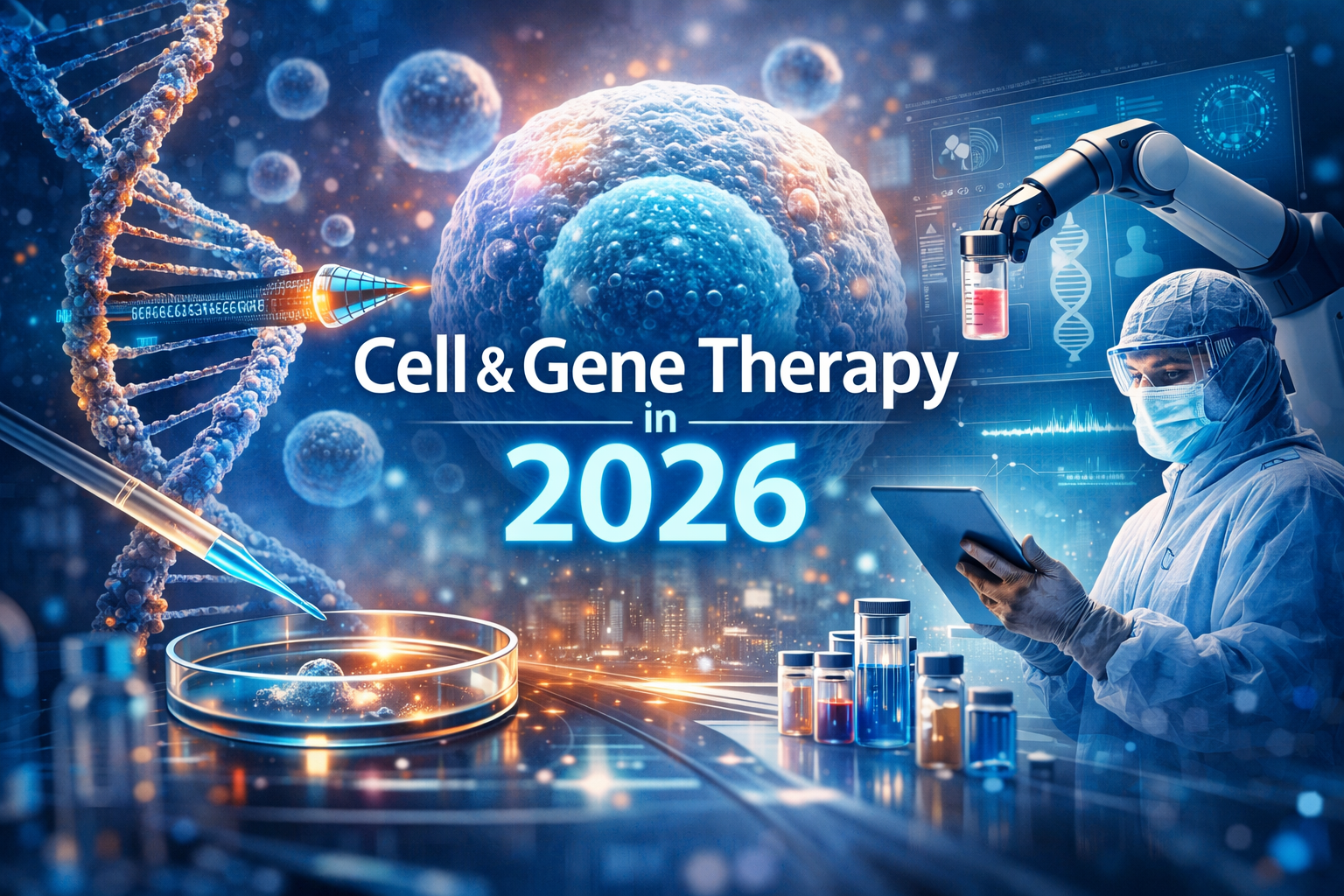
Image created through ChatGPT
In 2025, cell and gene therapy (CGT) showed growing clinical familiarity even as access and reimbursement challenges persisted. Providers and payers increasingly trusted and valued CGTs, supporting the continued expansion of late-stage programs. However, startup activity remained muted amid economic uncertainty, regulatory shifts, evolving therapeutic priorities and increasingly selective investors. Even though total deal value increased, the number of deals remained low, as buyers focused on fewer transactions that closely aligned with their priorities and relied more on milestone-based payments. The EY Firepower report described 2025 as a year of “smaller, smarter” dealmaking, reflecting a more disciplined and intentional approach across the market.
What mattered most was not deal volume but where capital flowed, as investment concentrated around late-stage clinical data, regulatory inflection points and strategic partnerships that signalled de-risked science and commercial readiness.
CGT dealmaking overview by quarter in 2025
In the first quarter (Q1) of 2025, a total of 90 CGT deals were recorded, 20 per cent fewer than in the previous quarter. Despite the overall slowdown, acquisition activity rose from seven to nine deals, reflecting sustained interest in de-risked assets. From a pipeline perspective, 27 non-genetically modified cell therapy trials were initiated in Q1 with 74 per cent targeting non-oncology indications, reflecting growing interest in autoimmune and inflammatory diseases. In contrast, 79 gene therapy trials were launched, with 57 per cent focused on oncology – the highest concentration observed over the past year.
In the second quarter (Q2), overall deal volume stabilized while acquisition activity increased to 12 transactions. This trend highlighted buyers’ growing confidence in deploying capital selectively, even as funding for early-stage companies remained limited. From a pipeline perspective, Q2 showed a renewed emphasis on RNA therapeutics targeting oncology, with the highest proportion of RNA oncology trials recorded in the past two years. This shift reflected increasing confidence in RNA-based approaches beyond vaccines and infectious disease, supported by continued advances in RNA delivery technologies and a clearer line of sight to oncology-focused clinical and commercial value.
By the third quarter (Q3), deal activity rebounded to 99 transactions, driven largely by partnerships and structured deals, whereas acquisitions dropped to just three. Buyers appeared more comfortable sharing risk than committing to outright acquisitions. Scientific momentum remained strong, with 125 trials launched across gene, cell and RNA modalities, indicating continued investment in clinical development even as capital markets grew more selective.
The fourth quarter (Q4) of 2025 showed more active CGT dealmaking, with heavier use of contingent value rights and milestone-based economics as a key signal. According to GlobalData, the average milestone payment for biopharma deals increased in Q4 compared with Q3. At the same time, market sentiment improved as the XBI, a biotech stock index, rose by almost 75 per cent from earlier lows to reach its highest level since 2021.
Which therapeutic areas had the biggest deals in CGT?
Autoimmune
In vivo cell therapy clearly stood out for investors in 2025, as it removes ex vivo manufacturing bottlenecks and makes cell therapy easier to scale. AbbVie acquired Capstan Therapeutics for up to US$2.1 billion to gain its in vivo CAR T platform that engineers immune cells directly inside the body for the treatment of autoimmune diseases and cancer. AstraZeneca followed a similar approach with its US$1 billion acquisition of EsoBiotec, whose ESO-T01 platform reprograms immune cells directly in vivo.
Cardiometabolic
Expanded gene-editing deal activity in cardiometabolic disease reflects a shift toward durable, one-time in vivo genomic therapies to replace lifelong therapies. Eli Lilly’s up to US$1.3 billion acquisition of Verve Therapeutics is centred on VERVE-102, a base-editing therapy designed to permanently lower cholesterol. The deal highlights Lilly’s push to shift cardiovascular care away from lifelong dosing toward durable, single-intervention treatments.
Renal
Addressing the rare genetic disorder autosomal dominant polycystic kidney disease (ADPKD) drove Novartis’ US$1.7 billion acquisition of Regulus Therapeutics. Farabursen is a potential first-in-class oligonucleotide targeting miR-17 with preferential kidney exposure. Phase Ib clinical data showed reductions in cyst growth and kidney volume along with signals suggesting delayed disease progression in ADPKD.
Ophthalmology
Big Pharma made its strongest move into ophthalmology in 2025, where durable, single-dose therapies could replace chronic injection regimens. Eli Lilly agreed to acquire Adverum Biotechnologies in a deal valued at up to US$260 million for Ixo-vec, an intravitreal gene therapy being developed for wet age-related macular degeneration. Just weeks later, Lilly also partnered with MeiraGTx in a deal worth more than US$400 million in potential payments, gaining access to its AAV-AIPL1 program for a severe inherited retinal disease supported by early clinical data.
What to expect in CGT dealmaking in 2026
In 2026, CGT dealmaking is likely to remain highly selective, reflecting the disciplined approach seen in 2025. While innovation will continue to matter, investment decisions will increasingly be shaped by deal structure evolution, international partnerships and shifting therapeutic priorities.
Evolving capital structures
Capital structures in life sciences will continue to evolve as investment capacity aligns more closely with opportunity. Mergers and acquisitions (M&A) activity in 2026 is expected to increase, supported by stabilizing financing conditions and selectively reopening equity markets. As outlined by Amanda Frick, private equity, royalty financing and minority investments are now mainstream tools for bridging late-stage development and commercialization. These structures provide added runway and flexibility for innovators constrained by earnings-per-share considerations, without immediate dilution. This dynamic is expected to persist into 2026, with private equity remaining active across pharma technology.
China-West collaboration
Cross-border collaboration is expected to remain a central driver of CGT dealmaking in 2026, as Chinese biotechs increasingly adopt multi-regional clinical trials and attract early-stage CGT development partnerships abroad. China’s biotech dealmaking reached record levels in 2025, with more than 140 China-related licensing and investment deals announced, and activity is expected to continue rising. Without strategic collaboration, Western markets risk not only losing leadership in innovation but also delaying patient access to emerging CGT therapies.
Therapeutic expansion
CGT will continue moving beyond its early experimental phase. Base editing is expected to play a much larger role as next-generation tools reduce DNA damage and enable multiple genetic modifications simultaneously. At the same time, companion diagnostics will evolve beyond single biomarkers, with multi-omics approaches improving patient selection and accelerating trial execution – making it more realistic to pursue chronic, rare and neurological diseases. Momentum will also continue to build around off-the-shelf immune products and next-generation immunotherapies that can be manufactured and delivered at scale, rather than highly individualized treatments. Developers will face increasing pressure to move away from niche inpatient settings toward cost-constrained outpatient care models, elevating the importance of durability, pricing discipline and health economic justification.
As CGT moves into 2026, the market is shifting from a period of caution to one focused on execution and strategic focus. The message from 2025 was clear: investors backed programs with strong clinical data and a realistic path to market, not scientific promise alone. In 2026, dealmaking is likely to centre on fewer, higher-conviction transactions, supported by more flexible capital structures, stronger cross-border collaboration and a growing focus beyond oncology into more common diseases. Ultimately, the next phase of value creation in CGT will be led by teams that can turn biological breakthroughs into therapies that are scalable, durable and economically viable.

Laya Kiani
Latest posts by Laya Kiani (see all)
- CGT dealmaking outlook: 2025 review and expectations for 2026 - February 12, 2026
- The non-dilutive funding path for biotech startups - October 22, 2025
- Sustainability in CGT: Evaluating LCA and manufacturing approaches - July 30, 2025


Comments