

Synthetic biology is an exciting discipline that, according to SynBio Canada, “represents a maturation of genetic engineering and biotechnology.” Medicine by Design names synthetic biology as an engineering design principle that will help accelerate breakthroughs in regenerative medicine. So how is synthetic biology having an impact now? The article below, by Chris Barnes and Alex Fedorec of University College London, first published in The Conversation, Canada edition, offers five examples of exciting research happening today.
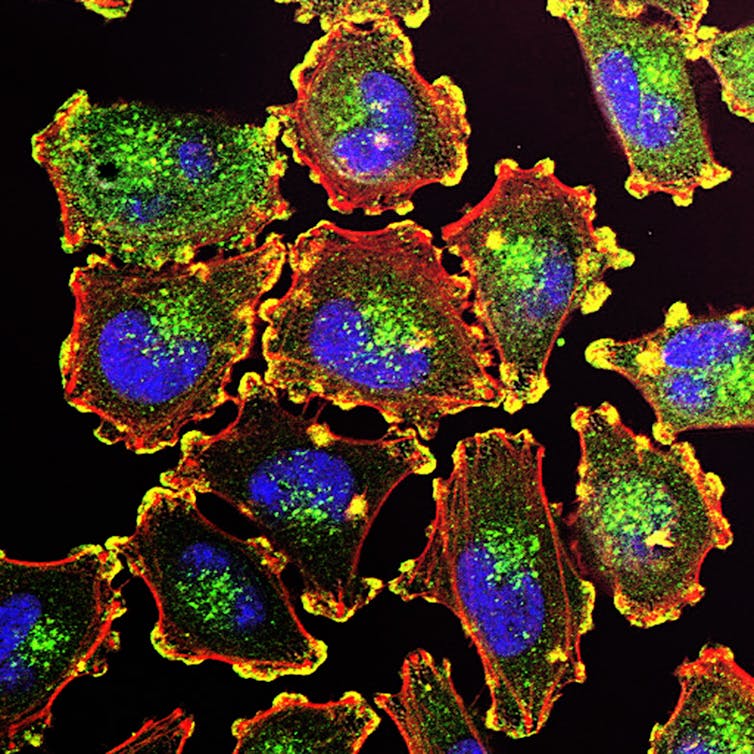
Cancer is the leading cause of death in the world. It occurs when mutations in our cells lead to unchecked growth. But what if we could engineer biological cells to fight back?
Synthetic biology is a rapidly developing discipline that allows us to encode new computational capabilities into DNA. In the same way that electronic circuits are made from components such as resistors and diodes with well defined functions, synthetic biologists make use of an ever growing library of genetic parts with functions such as switches and sensors. Using this toolkit, cells can be reprogrammed to detect and destroy tumours.
Here are five remarkable ways that synthetic biology could help us treat cancer in the future.
1. A tattoo for all cancers
Solid tumours within the body are often not detected until they are significantly developed. Increased calcium in blood is a signature of many cancers. Focusing on this, a group at Eidgenössische Technische Hochschule (ETH) Zurich have engineered cells to detect elevated levels of calcium in blood. Implanted under your skin, these engineered cells will respond to increased calcium levels by secreting melanin that cause the skin to darken. The hope is that these cells will temporarily tattoo the body, indicating that there is a potential problem needing further investigation.
2. Don’t miss the target
Once cancer has been detected, killing cancerous cells while sparing healthy ones is the next challenge. Researchers have built biological systems which mimic the behaviour of electronic logic circuits. DNA sequences can be designed that only produce a desired output when all of the necessary inputs are present.
In this case, one such “genetic logic circuit” has been developed to sense several microRNAs produced by cancerous growth, and thereby distinguish between healthy and tumour cells. Only when all of the microRNAs are present will the circuit produce the output, a single protein that causes the cancer cell to self-destruct. By detecting several signals, the chances of misclassification are reduced.
This treatment can be delivered by standard gene therapy techniques such as engineered viruses, which will spread through the body and “infect” cells with the genetic logic circuit.
3. Rebooting the immune system
Cancer cells have the dangerous ability to evade our immune systems. Given this, one approach to treat cancer is immunotherapy, which aims to stimulate the immune system to attack cancer cells. A group at Massachusetts Institute of Technology (MIT) recently engineered a gene circuit that identifies ovarian cancer cells. In this case, once cancer cells are identified, the circuit essentially paints a biological bullseye on them, directing the immune system to destroy the cancer. The advantages of this approach over existing immunotherapies is that a greater number of markers can be tested and more specific therapies achieved.
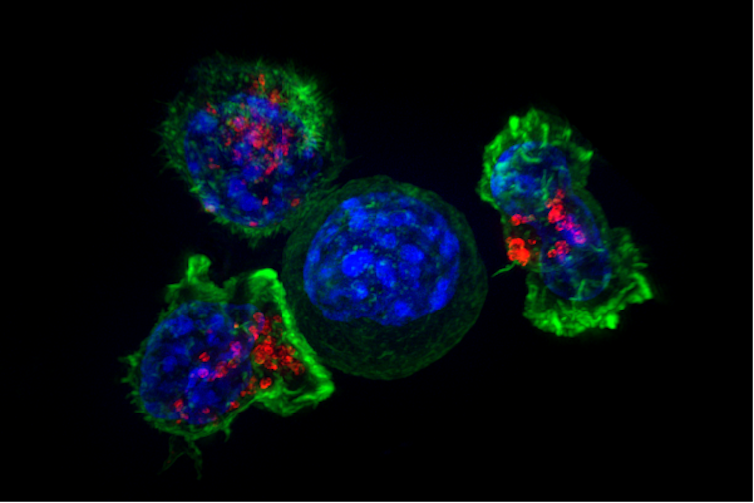
Alex Ritter, Jennifer Lippincott Schwartz and Gillian Griffiths, National Institutes of Health, CC BY
4. Reprogrammed microbes
Some types of bacteria, such as Salmonella, can live happily inside the tumour environment. These microbes can be engineered to detect and destroy tumours. One study, led by teams in San Diego and MIT, turned a probiotic strain of bacteria into a biosensor that could detect cancers in the liver and subsequently be detected in the urine with a simple colour change test. This type of system could in principle provide a non-invasive early warning screen for tumour developments. In another study by the same groups, weakened Salmonella strains were engineered to release an anti-tumour toxin into the tumour environment. The uniqueness of this system over previous approaches was that the gene circuit within the bacteria produced cycles of drug delivery, thus allowing larger therapeutic doses over a longer time period.
5. Broccoli has never tasted so good
We all know that eating greens is good for us, but engineered bacteria can make them even healthier. A group from National University Singapore (NUS) engineered a common probiotic bacteria to stick to colorectal cancer cells and convert a chemical in cruciferous vegetables, such as broccoli, into a strong anti-tumour agent. They demonstrated successful conversion of food intake into the drug and a significant reduction in tumour size using their treatment. Such an approach could be used as a preventative measure to stop tumours forming and also after surgery to clean up any remaining tumour cells.
Future challenges and goals
So far, the majority of these approaches have been tested using simplified tumour models in mice. So, care must be taken when extrapolating to human treatments. But as a first step they have undoubtedly shown great promise. Big challenges, particularly in the case of engineered microbes, are containment – ensuring engineered microbes don’t survive in the natural environment – and dealing with evolutionary pressures, which render the microbes ineffective. It is now clear that these challenges are not insurmountable and clinical trials of engineered bacterial therapies are already proceeding.
Synthetic biology will enable ever more sophisticated ways to treat cancer. These, combined with the knowledge generated from understanding how tumours evolve, provide hope that a significant reduction in cancer deaths can be achieved in the not too distant future.
Chris Barnes, Reader in Systems and Synthetic Biology, UCL and Alex J H Fedorec, PhD Candidate in Synthetic Biology, UCL
This article is republished from The Conversation under a Creative Commons license. Read the original article.


Stacey Johnson
Latest posts by Stacey Johnson (see all)
- Right Turn: Top 10 blogs from 2025 - January 9, 2026
- Right Turn: Season’s greetings and upcoming event - December 25, 2025
- Right Turn: Stem cell supplements: A growing market with growing risks - December 19, 2025


Comments