

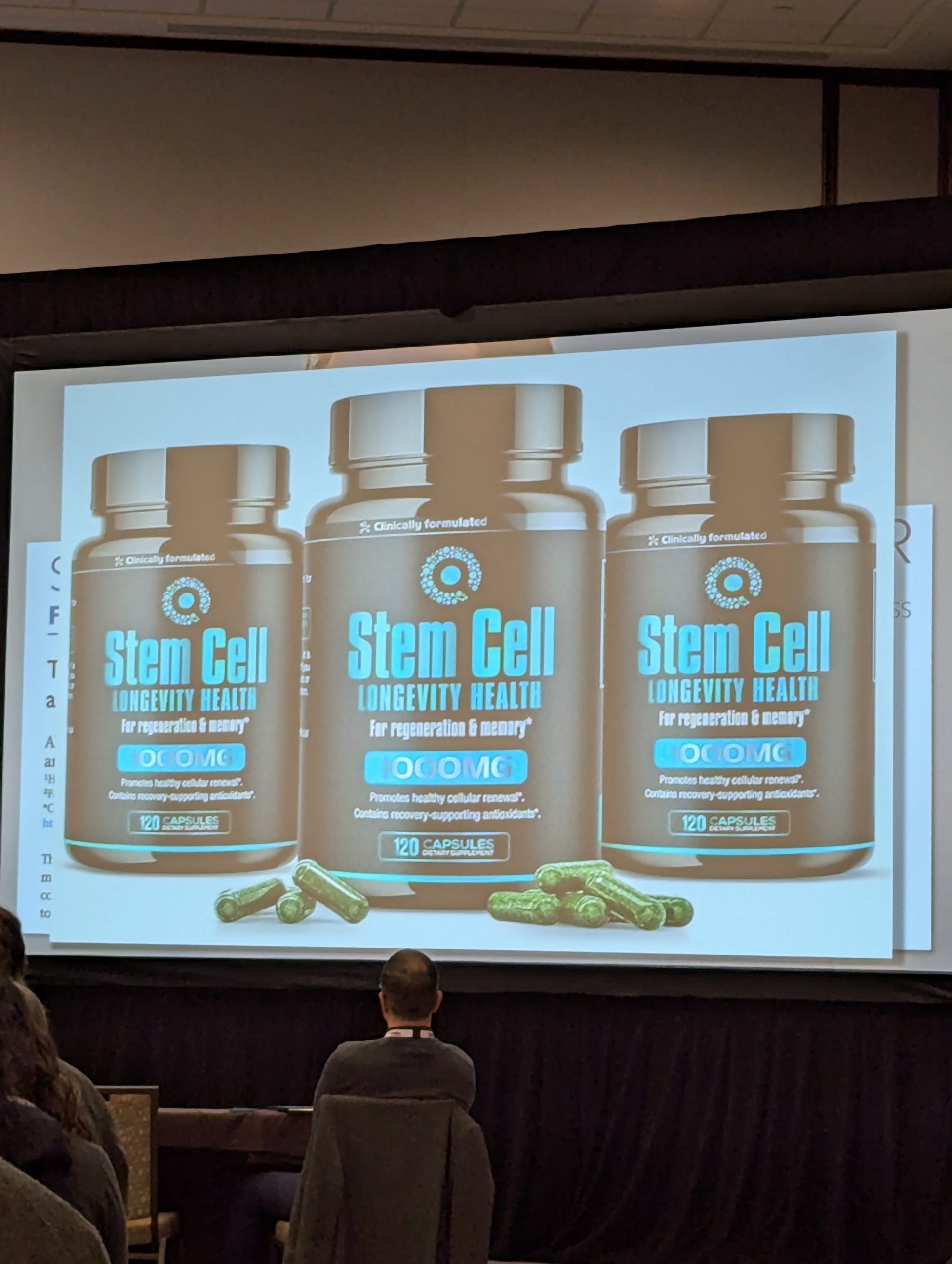
Slide from Professor Tim Caulfield’s keynote at the 2025 Till & McCulloch Meetings
A recent publication on the marketing of stem cell supplements, in the International Society for Stem Cell Research’s (ISSCR) Stem Cell Reports, sparked my curiosity about these products. While I haven’t been able to find a reliable source indicating how long stem cell supplements have been around, they are being marketed to enhance stem cell function, boost regeneration and slow aging. Experts agree that these products do not contain stem cells, even though they are often sold with language that suggests stem cell–like benefits, drawing heavily on the excitement surrounding legitimate advances in regenerative medicine. As interest in longevity and wellness surges globally, so too has the commercial market built around these claims. Yet for scientists, clinicians, and informed consumers, the expansion of this industry raises critical concerns about safety, evidence and regulation.
Although stem cell supplements are a relatively young category and estimates of this product’s valuation are hard to find, the global dietary supplements market is “currently worth more than 60 billion dollars,” according to a 2024 interview with Dr. Cara Welch of the U.S. Food & Drug Administration (FDA). Some forecasts estimate that stem cell–branded supplements were valued at around US$1.2 billion in 2023, with expectations of US$2.3 billion by 2030. Other reports, depending on how broadly they classify the category, place future valuations even higher – up to US$8.5 billion by 2028. (I was unable to independently verify the original sources for these figures.) Assuming that these figures are correct, the trend is unmistakable: there is consumer demand for regenerative-themed wellness products.
Interestingly, I found a couple of stem cell clinics that cater to stem cell tourism sharing their thoughts on stem cell supplements. They agreed that scientific evidence for claims made by stem cell supplements is weak and largely unproven. Perhaps not surprisingly, these clinics recommend their own services for treating patients.
Why caution is warranted
For the lay public, the term “stem cell supplement” can easily imply that the product has regenerative powers akin to cell therapies, an assumption that is inaccurate and potentially harmful to patient decision-making. In reality, there is no robust clinical evidence that any orally ingested supplement can significantly enhance stem cell function in humans or influence disease outcomes. Timothy Caulfield, a health law and policy expert with the University of Alberta, has stated that “the storage of human stem cells in pills, liquids, or capsules is scientifically implausible” and that advertising in this category often misuses stem cell–related terminology in ways that mislead consumers.
Several risks arise from this misconception:
- Misleading marketing may cause vulnerable patients to believe supplements can treat chronic conditions, leading them to delay evidence-based medical care.
- Advertisements often reference “boosting circulating stem cells” or “activating endogenous regeneration.” These statements are not supported by reproducible, peer-reviewed clinical research, as stated above, and undermine public understanding of stem cell science and risk eroding trust in the field.
- Like other dietary supplements, stem cell-branded products are subject to variable quality control. The FDA does not require manufacturers to verify purity or consistency before selling their products.
- The frequent use of stem cell–related language in marketing can create the impression of scientific legitimacy. This can contribute to public confusion about what stem cell research actually entails, and about the difference between rigorously tested biologics and over-the-counter wellness products.
Compounding this issue is the regulatory landscape. In the United States, dietary supplements – including those marketed as stem cell-boosting – do not require pre-market approval for safety or efficacy. Manufacturers may sell products without demonstrating effectiveness, and government agencies can intervene only after safety issues emerge. This differs from Canada, where manufacturers require a product licence from Health Canada before selling supplements.
While more regulatory oversight is needed, that caution isn’t always appreciated by the public. Nevertheless, several steps could improve the situation, namely: tightening claim standards; mandating clearer labelling and quality testing; promoting public education; and encouraging the scientific community to speak openly about concerns and engage directly with the public to debunk misconceptions.
An ongoing need for public education
Professor Caulfield, the final author of the Stem Cell Reports publication, was the keynote speaker at this year’s Till & McCulloch Meetings in Ottawa, Ontario. His educational and entertaining talk about misleading health claims, titled “Twisted, Chaotic, and Misleading: Is Our Information Environment Killing Us?” touched on stem cell supplements and how the spread of misinformation “is a defining characteristic of our time.”
While stem cell supplements are expensive, and there could be biological effects as they interact with medications, etc., the harm to society is also important, as Professor Caulfield emphasized. When the public associates legitimate stem cell science with unregulated supplements, the field risks reputational damage. This matters not only for academic integrity but also for the success of clinical translation, funding and public trust.
On January 29, 2026, CCRM, MaRS Discovery District and the Royal Canadian Institute for Science (RCIScience) will be hosting a public event entitled “Healthy skepticism: Combatting medical misinformation,” featuring a panel discussion to hear from leading communicators in science, social media and journalism. Register for the first MaRS Mornings of 2026 here. As part of the event, CCRM will be receiving the Logan Award for excellence in science communications from RCIScience. I hope you will join us for this worthwhile event.
Stem cell research holds enormous promise, but the commercial rise of stem cell supplements reflects both the excitement surrounding the field and the risks of scientific misappropriation. As the market grows, it becomes even more important for all of us to advocate for evidence-driven standards.
Ultimately, protecting the integrity of stem cell science requires vigilance, not only in the laboratory and clinic, but also in the marketplace.
Professor Paul Knoepfler, a biologist with UC Davis School of Medicine and a well-known stem cell blogger, does a fact check on stem cell supplements. Watch what he has to say on the topic below.


Stacey Johnson
Latest posts by Stacey Johnson (see all)
- Right Turn: Top 10 blogs from 2025 - January 9, 2026
- Right Turn: Season’s greetings and upcoming event - December 25, 2025
- Right Turn: Stem cell supplements: A growing market with growing risks - December 19, 2025



Comments