

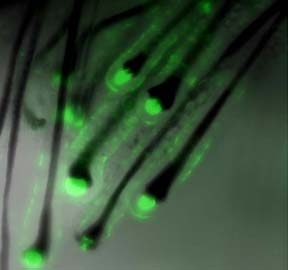
Hair follicles, courtesy of Jeff Biernaski’s lab, University of Calgary, Canada
At one point or another we’ve all experienced a bad haircut. We get over such minor annoyances secure in the knowledge that “it will grow back.” The ability of our hair to grow back is based on the amazing capacity of the hair follicle to undergo continuous cycles of growth and regrowth throughout our lifetime.
Based on this unique property, Dr. Jeff Biernaski, from the University of Calgary, has identified the hair follicle as an ideal system for studying regeneration. At last week’s Till and McCulloch Meetings in Toronto, Canada, Dr. Biernaski presented his work on a unique population of dermal stem cells (DSCs) located in the hair follicle. He emphasized the potential of these cells to be used as a regenerative therapy for burn victims.
Before I discuss the highlights of Dr. Biernaski’s talk, a bit of background on hair follicles and their resident stem cells. The skin is made up of two main layers: the epidermis—the layer exposed to the outside world, and an underlying layer of dermis. Embedded within the dermis are blood vessels, glands, nerves, and hair follicles.
The hair follicle contains an epithelial compartment and a dermal compartment. The epithelial compartment houses epithelial stem cells that give rise to all of the structures of the hair follicle. Dr. Biernaski’s primary interest is in a population of stem cells that reside in the dermal compartment. DSCs form the connective tissue sheath that surrounds the follicle, and a specialized structure called the dermal papilla. DSCs organize regeneration by telling epithelial stem cells when and how to build the hair follicle. (Click here to watch an excellent video, from the Biernaski lab, that describes this process.)
In the first part of his talk, Dr. Biernaski outlined elegant genetic lineage tracing experiments designed to prove that DSCs have the classic stem cell properties of multipotency and self-renewal. In other words, they can give rise to cells different from themselves, and replace themselves by generating identical daughter cells.
One of the interesting implications of this work is that it could help us understand the underlying causes of hair loss. Previously it was thought that general dysfunction in the dermal layer was responsible for the failure of hair follicles to regenerate. Thanks to Dr. Biernaski’s work, we can now pinpoint DSCs as the potential source of trouble in the dermal layer. While there are obvious applications to treating baldness, this work could lead to therapies for individuals who experience permanent hair loss due to chemotherapy or burns.
One of the most exciting applications of Dr. Biernaski’s work is to the improvement of existing skin grafting technology. Skin grafts effectively cover large areas of damaged epidermis; however, due to the lack of underlying dermis, they are often uncomfortable and fragile. Therefore, targeting the dermal layer for regeneration could improve the success of skin grafts.
Dr. Biernaski has chosen to use an autologous stem cell therapy approach to regenerate the dermis. This type of approach uses a patient’s own stem cells, thus avoiding the danger of immune rejection. The strategy is to harvest DSCs from the patient, transplant them back into the damaged area, and then place a traditional skin graft on top of the transplant site.
Dr. Biernaski presented data showing that transplanted stem cells survived, integrated, and, most importantly, improved the ability of epidermal cells in the overlaying graft to grow and divide. This work also demonstrates that transplanting cells in a supportive matrix improves their ability to survive and integrate into the tissue.
This opens the door for future combinatorial strategies that utilize biomaterials to improve the efficiency of cell therapy. We will watch with great interest for the next advancements out of this talented Canadian researcher’s lab.

Nicole Kuchinsky
Latest posts by Nicole Kuchinsky (see all)
- Three tips for navigating a career transition from academia to industry - February 24, 2021
- Second skin: A regenerative medicine approach to treating genetic skin diseases - December 5, 2017
- RMConnectTO: Building networks to advance regenerative medicine - October 12, 2017


Comments