

 To mark World AIDS Day, I revisited the rapidly shifting HIV cure research landscape, checking in on International AIDS Society (IAS) 2025 to see how things have evolved since 2021, when I last covered progress for Signals. Curative approaches are starting to move on from speculation to early demonstration. When working for the UK’s National AIDS Trust back in 2015, I remember how carefully we approached the subject of a cure. The emphasis was always on accuracy, responsibility and avoiding false promises.
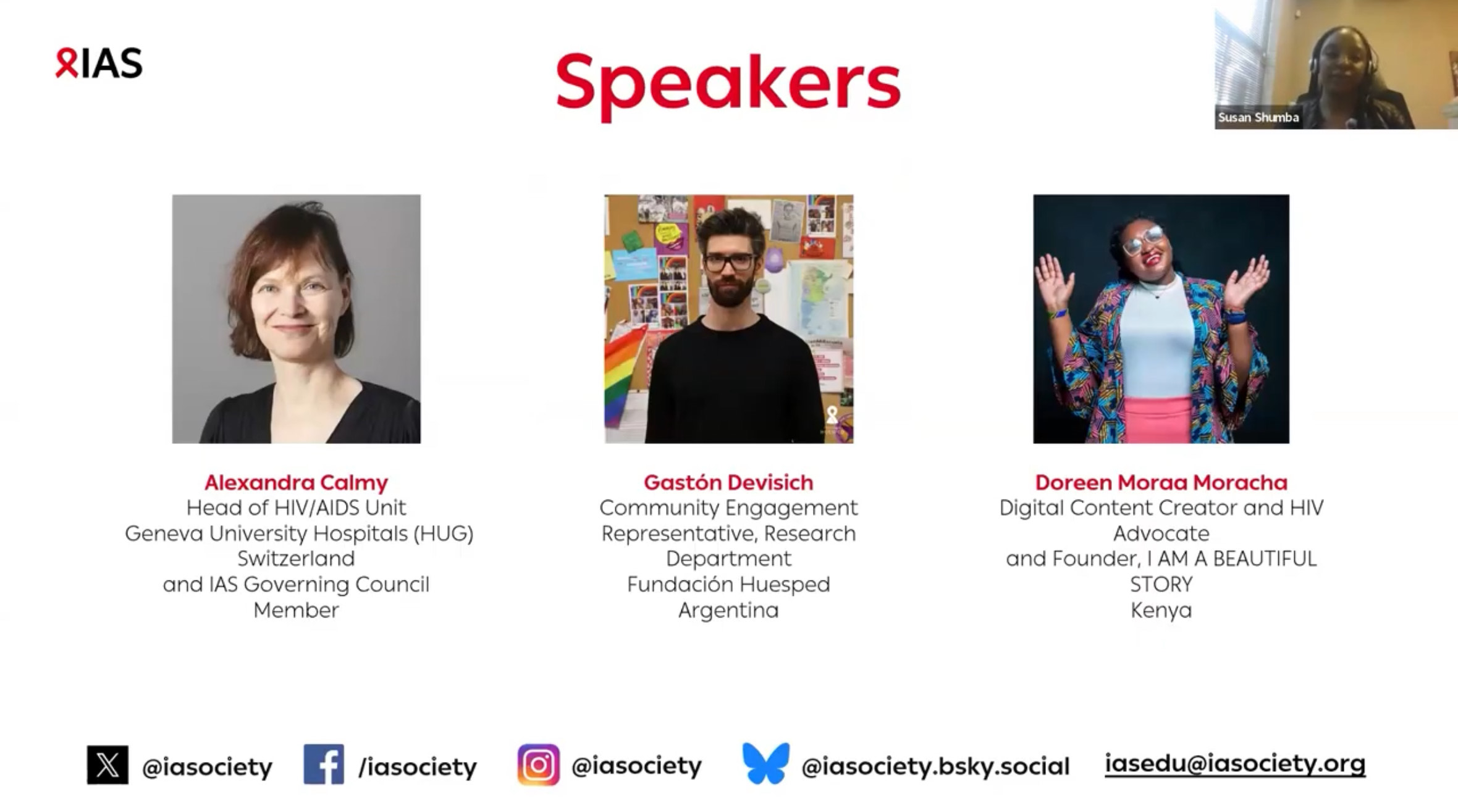
Opening her presentation at IAS 2025, Doreen Moraa Moracha, an HIV campaigner based in Kenya, reinforced this message, remarking: “Hope is not something that I take lightly. ARVs [Antiretroviral drugs] have kept me alive. Science has kept me alive. That’s why every breakthrough at IAS 2025 is personal to me because when science moves forward, so do our lives.”
Not a word was wasted in Moraa Moracha’s presentation as she shared perspectives from her community campaign work. “Communities are not just beneficiaries. Communities are partners in science, partners in solutions and partners in ending the HIV epidemic,” she emphasized while outlining the critical role community-led work will have in the success of any new or emerging therapeutic options.
“Science can’t save lives if shame keeps people away from clinics. That’s why community-led work matters because we fight stigma from the ground up,” she explained, a salient point given recent funding cuts, which UN AIDS warns are undermining community-led programs. “When funding is being cut… the first programs to suffer are the community programs. The peer educators, the outreach workers, the safe spaces, the mentor mothers, those things that make science real in people’s lives. Without community-led services, people drop out of care, prevention fails, stigma wins, science alone is not enough. We need science plus community funding. Take one away, and the response collapses.”
With that in mind, let’s take a look at some of the key emerging therapies. As I pull these all together, I’m noticing a theme: strengthening focus on functional cure strategies that control the virus without lifelong antiretroviral therapy, with several research groups now targeting deep viral dormancy or improved immune control.
Gene therapy approach to force HIV into dormancy
In a study of human immune cells infected with HIV published in May 2025 by Johns Hopkins Medicine, scientists say a molecule within HIV itself can be manipulated and amplified to force the virus into long-term dormancy, a state in which HIV does not replicate. This research opens up another new approach; instead of trying to flush out every hidden virus, it points to treatments that could keep HIV effectively silent, offering a new pathway toward long-term viral control and a functional cure.
AGT103-T gene therapy
American Gene Technologies (AGT) presented its gene therapy program at IAS 2025, also targeting a functional cure. This therapy involves modifying a patient’s own immune cells so they can attack HIV and maintain viral control without daily medication. In the small early study, the therapy led to detectable HIV-specific immune activity and the persistence of modified cells in all five evaluable participants, providing proof of principle that gene therapy could become a viable path toward durable remission. AGT plans futher trials in 2026 to validate these findings in a larger cohort and refine timing and monitoring strategies.
New stem cell transplant cure case
In July 2024, the seventh known cure case was presented at the 25th International AIDS Conference. The donor carried only one copy of the CCR5 delta 32 mutation, significant as earlier cases all involved donors with two copies of the mutation. This new result suggests that the window for compatible donors in experimental cure research might be wider than originally believed. Although stem cell transplants will never be routine in HIV care, each case provides insight into how HIV can be removed from the body entirely. These are proof-of-principle moments that inform the direction of future breakthroughs.
EBT‑101 CRISPR gene therapy update (2023–2025)
Excision BioTherapeutics’ CRISPR‑based therapy, EBT‑101, continues to make cautious but meaningful progress. In July 2023. The U.S. Food and Drug Administration granted Fast Track designation to the therapy and, in October of that year, the company presented interim Phase I/II clinical trial data: The first cohort (three participants) showed no serious side effects, building evidence around safety and effective delivery. Stopping antiretroviral drug therapy led to the virus returning in all three people, suggesting that the delivery or efficacy of the CRISPR edit needs improving. These results are still very valuable as they provide critical insight into what works, what doesn’t, and how future versions or doses could be optimized.
Progress in long-acting innovations also forms part of the wider picture. In June, Gilead’s Lenacapavir received FDA approval as a twice-yearly injection for HIV prevention. While it is not a cure or gene therapy-related technology, it signals an important shift in how treatment and prevention may evolve. Gilead has also been successfully testing a combination of Lenacapavir with broadly neutralizing antibodies (also delivered by injections every six months) for people living with HIV.
Reacting to these emerging long-acting options, Moraa Moracha said, “It gives people privacy, choice, dignity…Daily pills can feel like a daily reminder of HIV. Trust me, I have been on medication for the last 20 years. So, [Lenacapavir] gives freedom from that.”
Taken together, advances in gene therapy combined with long-acting technologies show a field that is maturing. The budding optimism is grounded by carefully accumulated evidence tackling the virus from multiple fronts. The story is not (yet) about any single breakthrough, but a collective shift toward solutions that are smarter, more precise and more mindful of patients’ needs.

Cal Strode
Latest posts by Cal Strode (see all)
- What’s in the mix for 2026: ARM’s State of the Industry briefing - January 28, 2026
- World AIDS Day: Update on HIV cure research and gene therapies - December 1, 2025
- Headwinds and tailwinds for cell and gene therapy under the second Trump administration - March 11, 2025


Comments