

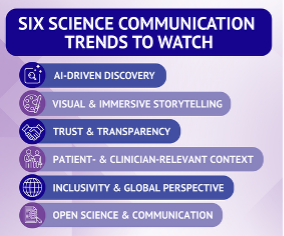
Infographic provided by the author
Science communication sits at the intersection of research, society and decision-making. However, in recent years, the space has become more crowded with artificial intelligence (AI)-generated content, influencer commentaries and monetized narratives, which are reshaping how science is interpreted, trusted and used. Both the creation and consumption of science communication are fundamentally changing.
In 2026, six trends are shaping how science, including advances in regenerative medicine and stem cell research, is explained and experienced.
Whether you are a science communicator yourself, or a regular consumer of news and content, this post will provide you with a roadmap for where the science communication field is going.
Trend 1: AI-driven discovery
AI is transforming how audiences find and engage with science. Science communicators are using AI tools to generate visuals, summaries and narratives from complex research, ensuring they resonate with the target audience(s). Platforms like Reelmind.ai can automatically convert datasets into animated visuals, explainer videos and interactive models, making dense research easier to understand and share. Other tools like ChartGPT and Google Charts help turn raw data into charts and narratives that resonate without advanced coding.
While AI can help to simplify, summarize and tailor information and content, communicators must also be aware of the potential harms to society that it presents. For example, using a third party to verify facts that AI presents can reduce the risk of publishing AI’s “hallucinations.” Read more about the challenges and opportunities of AI in science communication from the Stanford Social Innovation Review.
Trend 2: Visual and immersive storytelling
Visual formats are essential for breaking down complexity. Communicators are leveraging infographics and interactive graphics to make data compelling and accessible. For example, the Knight Lab at Northwestern University provides free tools, including Timeline for interactive timelines, and Juxtapose, for before-and-after comparisons, which are popular ways to illustrate change and process visually.
Frameworks and tools, like the “Using Multimedia & Visuals” section of the American Association for the Advancement of Science’s Communication Toolkit, help science communicators plan and produce high-impact visualizations.
Trend 3: Trust and transparency
In an October 2025 panel discussion called “Trust Issues: Science, Skepticism & Showing Up,” hosted by RCIScience, a panellist stated a key maxim of science communication: “The idea of transparency is indispensable to building trust.”
Audiences increasingly expect clarity about uncertainty, methodology and context. Responsible science communication, supported by organizations such as OECD.AI, emphasizes accurate and transparent explanations of scientific advances, avoiding hype and clearly stating limitations.
Tools that help annotate visuals with citations or versions, such as collaborative commenting systems in visualization platforms, support transparency by allowing audiences to trace back to original data and methods.
Trend 4: Patient- and clinician-relevant context
Effective science communication explains not just what was discovered, but what it means for real-world decisions. Narratives that combine patient experience with clear data interpretation help bridge research and practice.
Visual analytics platforms like TrialView demonstrate how clinical trial data can be presented interactively, helping clinicians and patients explore patterns and outcomes in an intuitive way.
Trend 5: Inclusivity and global perspective
Inclusive communication expands beyond translation to cultural context and accessibility. Tools that adapt content to include features like multilingual captions and sign language support help broaden reach. AI translation and adaptive glossaries in platforms like Reelmind.ai (also mentioned under the first trend above) can also assist these efforts by localizing science in multiple languages and literacy levels.
Inclusive practices also mean designing for diverse learning needs, whether through captioned videos, accessible websites or culturally relevant examples.
Trend 6: Open science and communication
As per the Government of Canada’s website, open science is the “practice of making scientific inputs, outputs and processes freely available to all with minimal restrictions.” It influences how research is shared and used. Science communicators play a crucial role in helping audiences interpret open science outputs, explaining uncertainty and the evolving nature of evidence.
Open science is not new, but I’m highlighting tools to assist science communicators. Common tools include the Open Research Knowledge Graph, which creates structured, machine-readable representations of research contributions, making it easier to compare findings, discover methods, and build narratives around evidence. Also, preprint servers such as bioRxiv and medRxiv accelerate dissemination, while open-access journals like PLOS One break down paywalls for broader public access.
Looking ahead, science communication will be less about broadcasting results and more about helping audiences understand and engage with science responsibly. By understanding and using AI tools, visual storytelling, trust-building practices, relevance, inclusivity and open science principles, communicators can connect complex research to society in meaningful ways.
If you’re aware of a new or emerging trend or tool that I’ve missed, please share it in the comments.

Laine Bodnar
Latest posts by Laine Bodnar (see all)
- Game-changing science communication trends to watch - April 15, 2026
- Right Turn: Ethics in science communication - April 8, 2025
- Regulatory affairs careers: What scientists need to know - March 18, 2025


Comments