

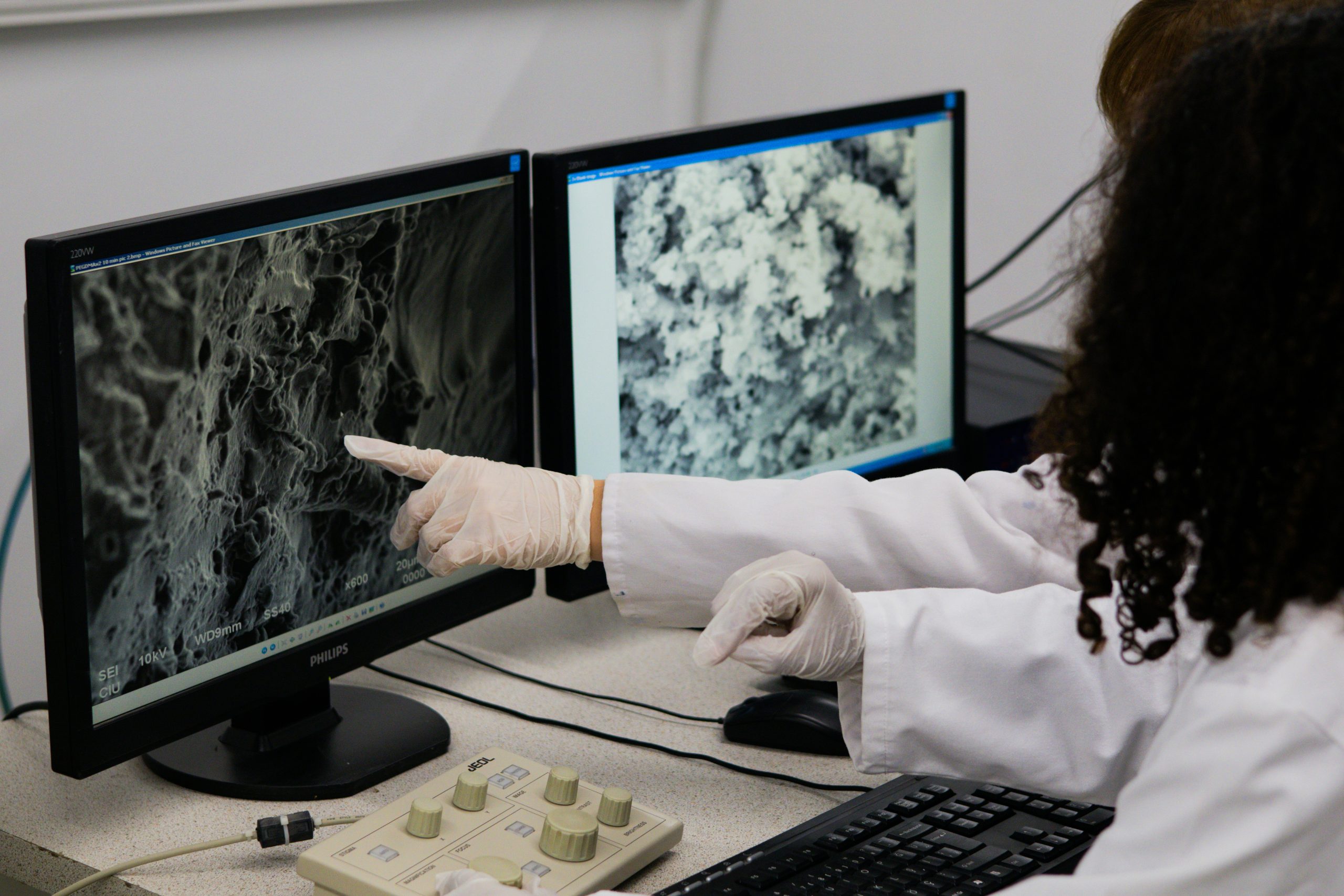
A scientist analyzing microscopy data. Photo by Faustina Okeke on Unsplash.
Cell therapy manufacturing generates large volumes of process data – from sensors, bioreactors, quality controls and genomic assays. In many facilities, much of that data are collected for regulatory compliance rather than for process improvement – a pattern that continues even as data volumes and sources grow.
The gap between data collected and data used has been identified as a recurring challenge in the field. Addressing it through better analytics tools, clearer data practices and workforce training may help improve manufacturing consistency and, in turn, patient access to therapies.
The data gap in biomanufacturing
The U.S. Food and Drug Administration (FDA) has framed data use as central to its Quality Management Maturity (QMM) initiative, which describes a progression from reactive, compliance-driven data practices toward a state where data actively inform manufacturing decisions. The framework identifies data literacy – the ability of manufacturing teams to interpret and act on process data – as a key factor in that progression.
Manufacturing performance and patient access
Autologous batch failure rates have been reported at up to 25 per cent for some indications, with each failure representing both a financial loss and a patient who does not receive their planned therapy. Research published in JCO Clinical Cancer Informatics found that increasing CAR T wait times from one to nine months raised predicted one-year mortality from 36 per cent to 76 per cent.
Data presented at the American Society of Hematology annual meeting found that approximately 26 per cent of myeloma patients died while waiting for commercially available CAR-T therapy, with limited manufacturing capacity and slot availability cited as contributing factors. These findings illustrate how manufacturing timelines can directly affect patient outcomes.
How data analytics are being applied
Automation and real-time monitoring are being explored as ways to reduce the manual handling steps associated with process variability. Process analytical technology (PAT) tools and machine learning models for metabolic pathway optimization are also moving from academic settings onto commercial manufacturing floors.
Several CDMOs and bioprocessing organizations in Canada and internationally are piloting these tools in cell therapy and biologics manufacturing, and full integration of these approaches across production workflows remains a work in progress industry-wide.
Canada’s position in the field
Canada has built relevant infrastructure and institutional capacity in cell and gene therapy manufacturing, though it operates in a global market where research and manufacturing investments vary considerably by jurisdiction. The Next Generation Manufacturing Canada (NGen) 2025–2026 Corporate Plan notes that scaling advanced manufacturing in Canada will require continued public and private investment to remain competitive internationally.
In 2023, Toronto, Ontario, was home to approximately 1,400 life-science businesses employing over 30,000 professionals. The Pan-Canadian Artificial Intelligence Strategy has directed investment toward AI adoption across key sectors, and NGen has set targets of CA$1.3 billion in total innovation investments and 15,000 new direct jobs by 2028. Programs like CanPRIME, CATTI and CASTL are working to address the workforce skills gap in biomanufacturing.
Organizations such as CCRM, NGen and BioCanRx are working to connect research, manufacturing and commercialization within the Canadian ecosystem. Whether those efforts translate into durable competitive strength will depend on continued investment and regulatory clarity.
The patient dimension
The figures on batch failures and waitlist mortality illustrate a direct connection between manufacturing performance and patient outcomes. When failures rise, patients lose their treatment slot. When release timelines extend, patients in serious condition wait longer.
Researchers have noted that improving manufacturing reproducibility and reducing process variability – as discussed in the Cell & Gene article cited above – are among the factors most directly linked to expanding patient access to cell and gene therapies. Better data practices are one component of that, alongside investment in capacity, workforce and regulatory processes.
Looking ahead
The AI-powered cell and gene therapy manufacturing market is projected to grow from approximately US$14.69 billion in 2025 to over US$122 billion by 2034. Which organizations and jurisdictions develop the manufacturing infrastructure and workforce capability to serve that demand is an open question.
Canada has research institutions, manufacturing capacity under development and many organizations working to connect those assets. Converting that into consistent industrial capability will require coordinated investment over time.
The tools for better data use in biomanufacturing are available and are being tested in practice. The evidence base for their value – as seen in the Blood Advances study cited above – continues to grow. How widely they are adopted will depend on investment decisions, workforce development and the degree to which data capabilities are built into manufacturing operations from the outset.

Sanat Khanna


Comments