

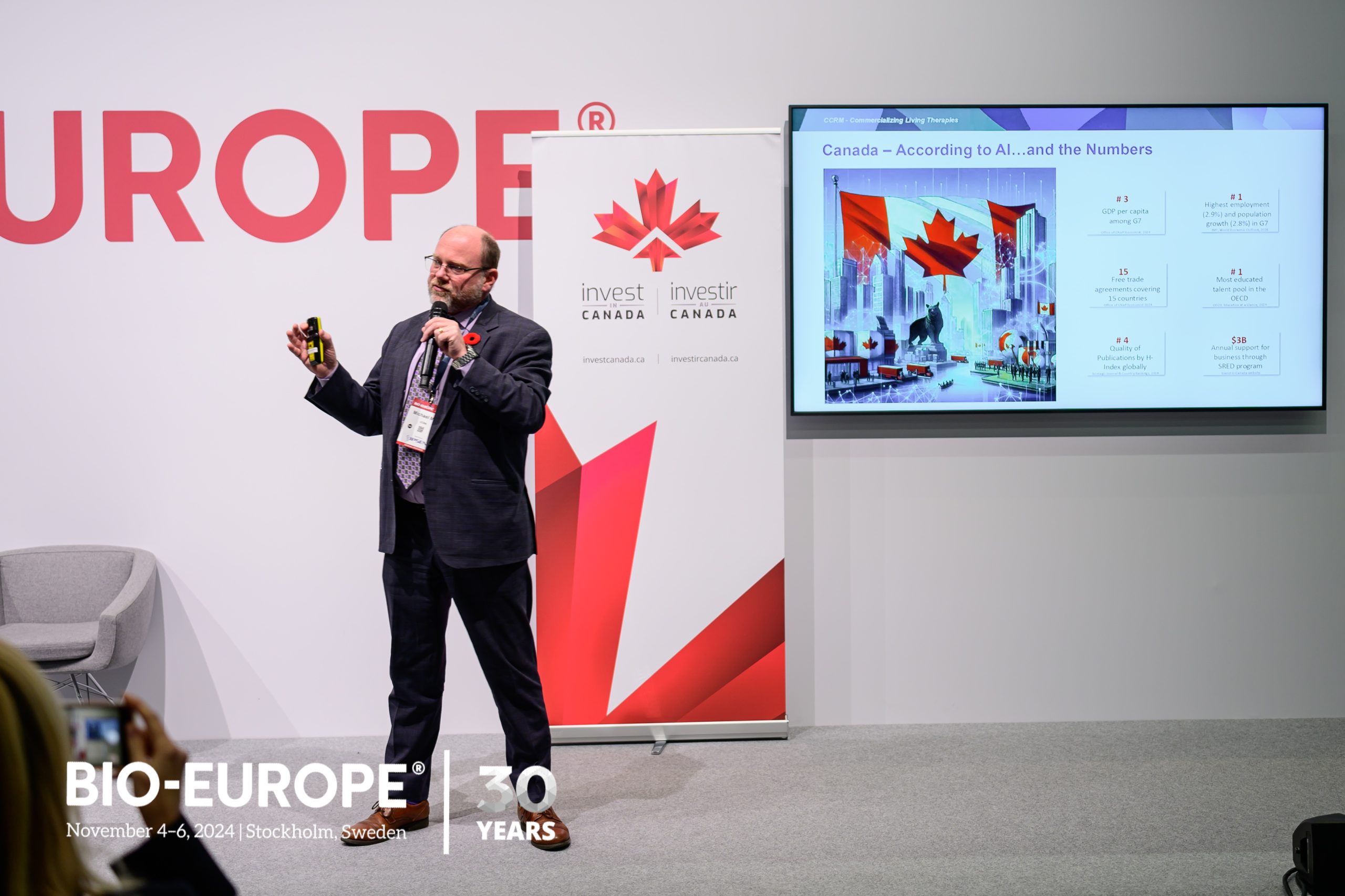
Michael May at Bio-Europe 2024. Image courtesy Felixfoto (Felix Buchele)
Fifteen years ago, regenerative medicine in Canada stood at an inflection point. The science was world-class, the academic talent was undeniable, and the promise of cell and gene therapies was beginning to capture global attention. Yet there was a critical problem: too many discoveries were trapped in laboratories, unable to navigate the long and complex journey to commercialization and patient care. Into that gap stepped the Centre for Commercialization of Regenerative Medicine (CCRM), an organization built not only to advance science, but to connect people, capital, infrastructure and ideas in ways that could transform an emerging industry.
The origins of CCRM are deeply tied to my story and that of CCRM’s co-founder, Dr. Peter Zandstra. This blog will share my motivations and inspirations for establishing CCRM.
I was raised in rural Ontario near the Grand River and close to where Alexander Graham Bell lived. I learned about Bell at an early age and was inspired by his blend of invention, experimentation and social impact. Bell’s telephone revolutionized communication, while his work with the hearing impaired reflected a commitment to improving lives through innovation. Decades later, BlackBerry’s development of the smartphone along the same river reinforced another lesson: transformational technologies often emerge where networks of talent, entrepreneurship and infrastructure converge.
While studying chemical engineering at the University of Toronto, I saw transformative research taking place. One thing that struck me was how slowly promising discoveries moved toward patients. That realization became a defining mission: To accelerate the translation of breakthrough science into viable therapies and sustainable companies.
With one company under my belt – Rimon Therapeutics – I was offered an exciting opportunity in 2010. MaRS Innovation (now TIAP), the Stem Cell Network, leading regenerative medicine researchers and the University of Toronto asked me to design a commercialization strategy for Canada’s emerging regenerative medicine sector.
Armed with $15 million in seed funding from the Government of Canada and a broad coalition of partners from academia, government, industry and investment, CCRM launched in 2011 with a mandate unlike traditional research organizations. Its role was not to fund science, but to build the ecosystem required to turn scientific promise into real-world impact.
Over the next decade and a half, CCRM has become one of the defining organizations in Canada’s regenerative medicine landscape. It operates at the intersection of science, business and investment, helping bridge the so-called “valley of death” that often prevents early-stage technologies from reaching commercialization. CCRM has supported hundreds of academic and industry projects, helped launch and scale dozens of companies, and contributed to attracting hundreds of millions of dollars in investment into the sector. CCRM’s role in gene therapy company AVROBIO and its 2019 initial public offering enabled CCRM to seed its for-profit investment arm, CCRM Enterprises.
Indeed, several of Canada’s most recognized regenerative medicine success stories carry CCRM’s fingerprints. BlueRock Therapeutics, now a subsidiary of Bayer AG, emerged as a global leader in cell therapies for neurological and cardiovascular diseases. Notch Therapeutics advanced innovative stem cell-derived immunotherapies before being acquired by Roche. Montreal-based ExCellThera has advanced technologies to expand blood stem cells for transplantation and other applications, generating best-in-class clinical outcomes. Together, these companies demonstrate that Canada can generate globally competitive regenerative medicine companies rooted in domestic science and talent.
Thanks to Peter Zandstra, CCRM recognized earlier than many others that manufacturing would determine whether cell and gene therapies could become scalable, accessible health care solutions. Unlike traditional pharmaceuticals, these therapies require highly specialized production processes involving living cells, viral vectors and sophisticated quality controls. Manufacturing complexity has become one of the industry’s greatest bottlenecks and a primary reason why therapies remain so expensive.
CCRM responded by investing heavily in biomanufacturing capabilities, process development and analytics. A momentous achievement was establishing OmniaBio Inc. in Hamilton, Ontario. As Canada’s largest cell and gene therapy contract development and manufacturing organization, OmniaBio represents a major strategic asset for Canada. It provides the infrastructure needed to manufacture therapies from preclinical stages through commercial production, helping ensure promising treatments can move beyond small clinical trials and toward widespread patient access.
The importance of accessibility cannot be overstated. While the global cell and gene therapy market is projected by multiple analysts to exceed US$200 billion within the next decade, there is a growing tension between innovation and affordability. Approved therapies today often cost hundreds of thousands or even millions of dollars per patient. Those price points create enormous challenges for health-care systems, and they raise difficult questions about sustainability and equity.
The future of regenerative medicine, therefore, will not simply be measured by scientific breakthroughs, but by whether therapies can become accessible to the patients who need them most. Not every disease or condition will require, or justify, an expensive, highly personalized cellular therapy. The industry is increasingly recognizing the significance of prioritization: Focusing advanced therapies where they can deliver transformational outcomes for patients with serious unmet medical needs, particularly in areas where conventional medicines fall short.
This is where CCRM’s next phase becomes especially critical. The organization is now evolving from a Canadian innovation hub into a global network model. Existing international hubs in Australia and Sweden demonstrate how CCRM’s ecosystem-building approach can be replicated and adapted in other regions to accelerate regenerative medicine development worldwide. Rather than operating in isolation, these hubs are designed to work collaboratively and synergistically, sharing expertise, infrastructure and investment opportunities across borders.
At the same time, CCRM is positioning itself at the forefront of transformative technologies that could reshape the future of the field. Through its collaboration with IonQ, CCRM has established DeepTech Bio Lab™, a centre of excellence focused on integrating quantum computing, artificial intelligence (AI) and emerging technologies to accelerate biotech companies, especially those in advanced therapies. The initiative reflects a broader recognition that biology is becoming an increasingly data-intensive and computationally complex field. AI-driven discovery tools, advanced modeling systems and quantum-enabled optimization may eventually help reduce development timelines, improve manufacturing efficiency and lower costs.
What has distinguished CCRM throughout its history is its understanding that innovation ecosystems matter as much as scientific discovery itself. Talent pipelines, manufacturing infrastructure, investment networks, public-private partnerships and global collaboration are all essential ingredients in building a sustainable regenerative medicine industry.
Cell and gene therapies have been proven to work. As CCRM enters its next chapter, the challenge now is scaling these therapies responsibly, affordably and globally. If you’d like to help, let’s connect.

Michael May
Latest posts by Michael May (see all)
- Why I helped build CCRM: A journey from inspiration to impact - June 9, 2026
- 10 days ago in Toronto…. - August 22, 2023
- Thinking about longevity makes me feel old - August 25, 2021


Comments