

I went down a bit of a rabbit hole the other day, as one often does on the internet and/or social media. In my defence, I was looking for inspiration for my next blog post – this one – and I found some.
It started with this parody song about placebos, by anesthetist Dr. Suman Biswas, which The BMJ posted on X in two parts. I thought maybe it was time for a light parody post, so I was looking for one link that I could share. This led me to The BMJ’s “Creating a healthier world” YouTube page, which features podcasts, explainer videos, webcasts, and more.
And that sent me down a different rabbit hole: how do we know whether the health information we encounter online is trustworthy?
Turning to social media for health information
I was immediately enticed to watch “How the Internet Hijacked Our Health” since this topic dovetails with my interest in misinformation and disinformation. BMJ editor Kamran Abbasi interviewed author Dr. Deborah Cohen about her new book of the same name (Bad Influence: How the Internet Hijacked Our Health), marketed by the publisher as follows: “When did we start trusting influencers over doctors? You used to see a doctor. Now you go online.” The short answer to the question above is: during the COVID pandemic. For a more nuanced answer, read Cohen’s book, shortlisted for the 2026 Royal Society Science Book Prize.
I don’t think it will surprise you to read that tens of millions of Americans now turn to social media to obtain health information, according to the Pew Research Center. Canadians do as well.
The ISSCR’s Stem Cell Reports has covered the rise of health information on social media, in this case focusing on YouTube. Authors Anders Grundtvig, University of Copenhagen, and Megan Munsie, University of Melbourne, write about “Stem cells in your YouTube feed: The complex landscape and unexpected mediators of online information” and rightly point to the concerns that “authority, reliability, and accuracy” may be sacrificed.
Focusing on stem cell treatments on YouTube, they note that “misinformation already abounds online about unproven stem cell procedures,” so their analysis instead focused on mapping these videos and identifying the mediators and content creators behind them. They collected metadata from 4,481 YouTube videos across 1,734 YouTube channels. There was lots of engagement (comments and likes) and over 134 million views. Read their analysis here.
Drs. Grundtvig and Munsie found that “one influencer, above all others, appeared to have the most impact – Joe Rogan.” I’m not surprised. In 2019, I wrote an open letter to podcaster Joe Rogan about his endorsement of unproven stem cell therapy. In the stem cell space, he is a prominent and problematic advocate. In 2023, I blogged about him a second time. You can read my “interview” with Joe Rogan.
The source matters
Obtaining health information from the internet and social media isn’t necessarily problematic, depending on who you are following and trusting. For example, the College of Physicians and Surgeons of Ontario (CPSO) has developed social media policies prohibiting doctors from posting false or deceptive information. The CPSO also provides advice to Ontario physicians about their use of social media, and outlines what it considers unprofessional behaviour. If doctors are making claims that contradict established, evidence-based public health guidelines without providing reliable sources, that should be a red flag.
Of course, many health and wellness influencers are not doctors, nor do they have to abide by a professional code of conduct. Some have enormous audiences despite having little or no relevant scientific or medical expertise. For example, while some call actress and Goop founder Gwyneth Paltrow a wellness guru, a Toronto-based nutritionist described her as the “reigning queen of problematic wellness misinformation and disinformation.”
Timothy Caulfield, a Canadian professor, health law expert and science communicator known for debunking medical myths and addressing misinformation, went so far as to title his 2015 book Is Gwyneth Paltrow Wrong About Everything: When Celebrity Culture and Science Clash.
More recently, Caulfield and University of Alberta law colleagues Alessandro R. Marcon and Blake Murdoch published an article in the Canadian Journal of Bioethics titled “Influencers and Unproven Health Claims: Curbing Misleading Promotion in the United States and Canada.” They examine the state of legal prohibitions and enforcement relating to misleading advertising – such as for unapproved stem cell treatments – which the authors deem “inadequate,” and they describe the public health harms and how health misinformation erodes trust in public institutions, among other things. They suggest that artificial intelligence could assist with enforcement.
Online sources to keep you healthy
So, what are some reputable sources of health information? There are many! I’ve already mentioned The BMJ’s “Creating a healthier world” above. Naturally, there are medical institutions, hospitals, health charities, government agencies, and other organizations whose mandate is to provide evidence-based information. If you like to watch videos, the Canadian Medical Association (CMA) has its “healthcare for real” site, and it includes videos. In the stem cell field, visit Dr. Paul Knoepfler’s website. With blogs, videos, and educational materials, his site is a great resource.
Spending time online has its benefits. It turns out that the lighthearted parody song led me to a serious question about whom to trust with our health. In the end, it was a healthy distraction.
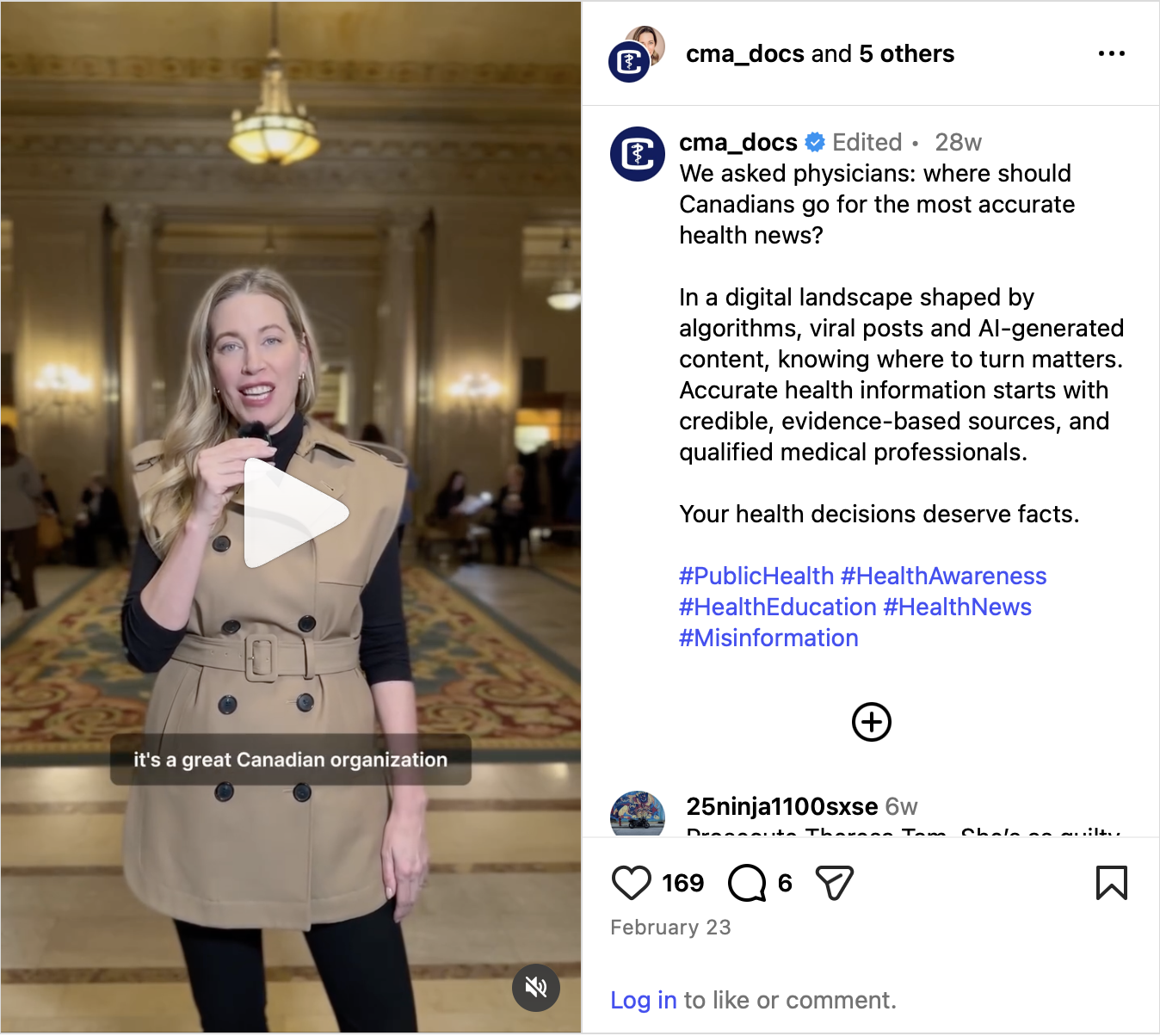
The CMA asked physicians to recommend sources for accurate health information. You can watch this video posted to Instagram. Add your own recommendations in the comments below.


Stacey Johnson
Latest posts by Stacey Johnson (see all)
- Right Turn: Healthy distractions - September 18, 2026
- Right Turn: The women’s health gap is also an innovation gap - September 4, 2026
- Right Turn: The real science, real benefits and real risks of peptides - August 7, 2026


Comments