

As someone who regularly consumes broadcast and print news, I can confirm that coverage, analysis and opinion pieces on artificial intelligence (AI) are everywhere. AI is coming for our jobs, but it will also happily recommend a new one for us. AI has the potential to accelerate medical and scientific discoveries, enhance education, boost productivity and automate routine tasks; except for the ability to experience human emotions, judgment and creativity, there isn’t much that AI can’t do. For everything else, there is quantum computing.
Nine months ago, CCRM established DeepTech Bio Lab™ (DTBL) and announced its first partner: IonQ, a global leader in quantum computing. Since December 2025, DTBL has put business, legal, financial and governance infrastructure in place; set up workstreams and developed strategic plans; begun executing projects; developed branding tools and created marketing materials; and recently hosted a workshop and an event, to name just a few accomplishments.
Highlights from “Quantum Leap: A New Era in Advanced Therapies”
On September 16, 2026, DTBL hosted “Quantum Leap: A New Era in Advanced Therapies,” at BioLabs University of Toronto, in Toronto, Ontario. The event brought together industry leaders, investors and innovators to explore how quantum computing, AI and other emerging technologies can revolutionize advanced therapies.
The program included an overview of DTBL; an introduction to quantum computing by Sumner Alperin-Lea, Quantum City; a discussion of quantum in life sciences by Zheng Cui, IonQ; and a life science use case presented by Evgeny Epifanovsky, IonQ. The final talk was an investor view of quantum by Cynthia Lavoie, CCRM Enterprises Inc., and Steve Tregay, Mission BioCapital. A lively panel discussion followed, and the event ended with a networking reception.
Recognizing the growing importance of data and deep tech solutions, DTBL was established to identify high-value life science challenges and determine where advanced computational technologies can create measurable impact. DTBL is intended to serve as a collaborative and neutral ecosystem builder rather than a technology developer itself. As Michael Israels, CCRM’s Chief Financial Officer, noted in the kickoff presentation, DTBL focuses on practical application rather than technology development for its own sake.
The following slide, presented by Michael Israels, outlines how DTBL could deploy emerging technologies to increase efficiency and reduce the cost of advanced therapies.
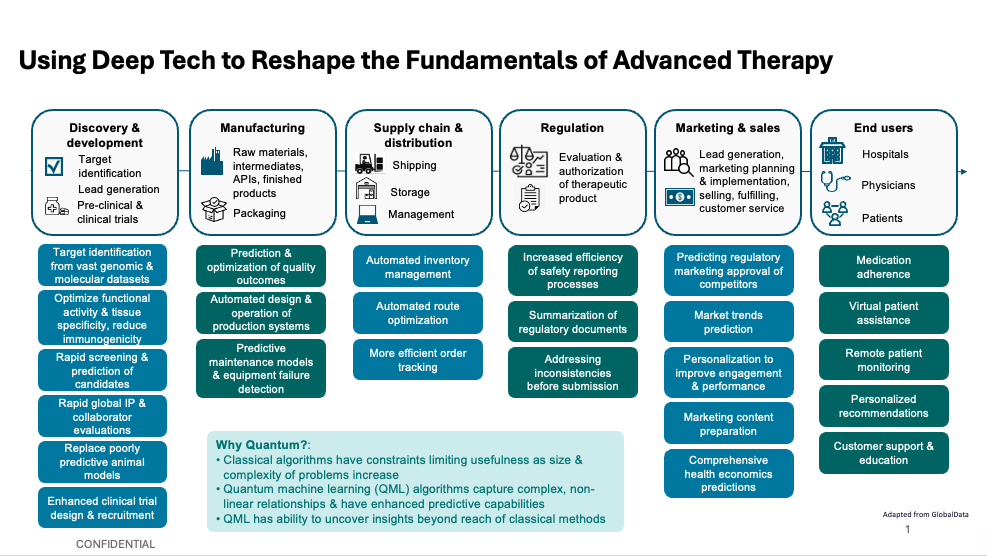
Image courtesy of DeepTech Bio Lab
Jessica Tate, CCRM’s Vice President, Vector Platform Technology, also spoke about DTBL and explained how it could optimize the lentiviral vector purification process, which currently takes many months and can involve substantial financial losses and delays if manufacturing fails. To optimize the process, DTBL would use computational modelling, AI, automation and quantum techniques. The objective would be to reduce development timelines, improve yield and decrease manufacturing costs while maintaining viral particle integrity.
Speaking of manufacturing, we heard that biomanufacturing is a major area for computational innovation. Potential applications include process optimization, supply-chain management, advanced analytics (data as a strategic asset was also mentioned), process control, manufacturing simulation (using technology to model, experiment and optimize your production process using digital models of your manufacturing environment) and resource allocation.
When Cynthia Lavoie, President and Chief Investment Officer of CCRM Enterprises, gave her talk, she emphasized that DTBL acts as an evaluation and validation platform for emerging opportunities before investment decisions are made. In the second part of the investment presentation, Steve Tregay, Managing General Partner, Mission BioCapital, noted that approximately one-quarter of emerging companies entering their ecosystem now identify advanced computational capabilities as a core differentiator. His message was clear: start by solving a valuable problem. Technology selection should follow from the problem, not precede it.
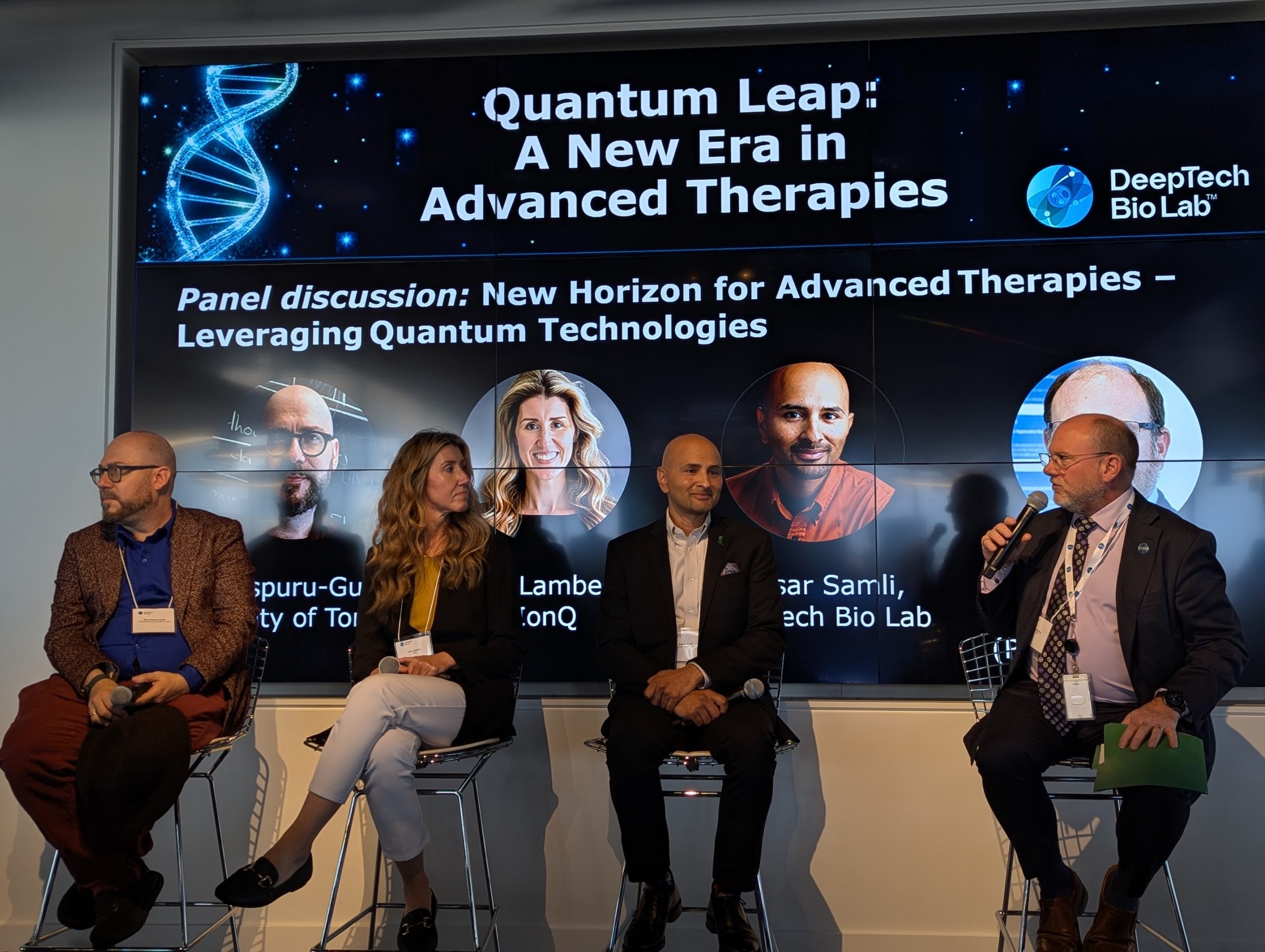
Photo: panel discussion with (l-r) Alán Aspuru-Guzik, University of Toronto, Lisa Lambert, IonQ, Kausar Samli, DeepTech Bio Lab and Board Director, Genome BC; and Michael May, CCRM (moderator).
A lively panel
The panel discussion opened with a question about what has changed of late to enable us to focus this conversation around real-world applications of quantum computing. The answers included: improved quantum hardware; better algorithms; more sophisticated software tools; growing talent pools; and stronger industry partnerships. In other words, the conversation has shifted from “What can quantum computers do? to “Which real-world problems should quantum computers solve?”
The panellists emphasized the importance of collaboration among key stakeholders and described the field as a “team sport” requiring continuous collaboration between technical and domain experts.
Repeated again during the panel was the message that commercial success depends on solving meaningful problems, not simply adopting trendy technology. We shouldn’t be distracted by “quantum pixie dust.” Successful companies will identify an important problem, understand customer needs, determine whether quantum methods can create genuine value and build solutions around measurable outcomes.
A central theme throughout the event was that life sciences and advanced therapies face increasingly complex biological, manufacturing and data challenges that traditional approaches may struggle to solve efficiently. We heard that AI/ML, quantum computing, automation and robotics are converging to create new opportunities for innovation across the entire biotechnology value chain.
The panellists expressed optimism that quantum-enabled applications will begin appearing in life sciences workflows over the coming decade and concluded that many of the most important opportunities will emerge through the convergence of quantum computing, AI, advanced analytics and biological expertise.
A little quantum homework
While those of us in the room learned about the fundamentals of quantum computing from Dr. Alperin-Lea, I recommend you watch the videos below rather than relying on this English major to disentangle (quantum pun intended) this topic.
If you want some fun with your physics, the novel Dark Matter, by Blake Crouch, is an enjoyable read. I read it about a decade ago and enjoyed this sci-fi, mystery, suspense/thriller, and felt a little wiser afterward. It has been turned into a series and is now streaming. The other night I watched Season 1, Episode 1, and was amused to see the protagonist teaching his university class about Schrödinger’s Cat. Dr. Alperin-Lea also discussed the famous, fictional and fateful feline in his presentation.
Watch IonQ’s “What is Quantum Computing?” below and the follow-up video, “How does quantum computing work?” at this link: https://www.youtube.com/watch?v=uqBiCvRRVz4&t=28s


Stacey Johnson
Latest posts by Stacey Johnson (see all)
- Right Turn: Exploring quantum computing and its real-world impact for advanced therapies - October 2, 2026
- Right Turn: Healthy distractions - September 18, 2026
- Right Turn: The women’s health gap is also an innovation gap - September 4, 2026


Comments