

Guest post by Paul Knoepfler, cross-posted on ipscell.com
This morning I particularly enjoyed a talk by Sui Huang [ed note: this talk also discussed here] focused on the application of mathematics as a tool to understand cell behavior and fate. I love this stuff! I just wish I was better at math and physics so I could have a deeper understanding of how they apply to stem cells. Huang is a true expert in this area.
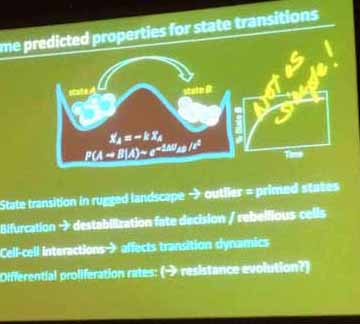
I have to admit that I did not understand all of his talk, but I found it thought-provoking. Two things I confess to not entirely understanding that were mentioned: Pitchfork Bifurcation and Quasi-discrete phenotype transformations.
When Huang combined the words and images together I started to get a better intuitive sense of what it all meant and how it helped us understand stem cell fate.
Above is one of his pictures of hills, mountains, landscapes, and rolling stem cells. Cells needed to get over the peaks to take on new fates in new “states”, right? Energy is involved. I had a lot to think about.

Later after an interesting ethics seminar, I went for a nice hike along the Bow River to get back to nature and let all these ideas from the day get processed in my head. As I was taking everything in that this natural wonderland had to offer, something resonated in my head as familiar. Hmm, what could it be?
Can you guess what it was that seemed familiar from the picture just above here I took on my hike?
OK, so not everyone sees a mountain and imagines stem cells rolling around on it, but what can one do? I think I’m getting a handle on Pitchfork Bifurcation and Quasi-discrete phenotype transformations….and Banff definitely has something do with it.

Guest
Latest posts by Guest (see all)
- Regenerative immunotherapy: Hope for chronic autoimmune diseases - September 16, 2025
- Canada’s regenerative revolution: Why AI is the catalyst - September 4, 2025
- Summer by Design: A launchpad for future entrepreneurs and industry scientists - August 14, 2025



Trackbacks/Pingbacks