

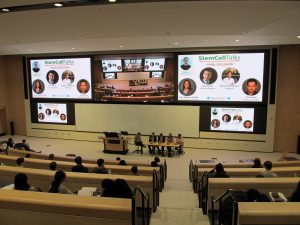
StemCellTalks 2019 at the University of Toronto
Eleni Kanavas is a science communicator with more than eight years of work experience in the academic and health science fields. She is the Acting Communications Specialist at CCRM. She completed her Honours Bachelor’s Degree in Journalism at the University of Toronto and previously worked at Sunnybrook Research Institute and the University of Toronto Scarborough Campus.
The first time I heard about macular degeneration was over a decade ago when my Grandmother was diagnosed with the age-related eye disease that causes blurred or almost no vision in the centre of the visual field. Not knowing much about this irreversible eye condition at the time, my family turned to ophthalmologists and specialists for treatments to help stop the progression of blindness. At age 87, my grandmother has adapted to a healthy lifestyle with low vision.
That being said, you can say there is light at the end of the tunnel thanks to the hard work of the scientists and research teams in the field of regenerative medicine. On February 22nd, I had the opportunity to learn about retinal stem cell research and the advances being made to treat patients with macular degeneration at the annual StemCellTalks Symposium hosted by the University of Toronto chapter of Let’s Talk Science, a leading national, charitable organization committed to building youth interest and engagement in science, technology, engineering and mathematics.
Now in its 10th year, StemCellTalks is a national stem cell outreach and education initiative for Canadian high school students run in partnership with Let’s Talk Science and the Stem Cell Network. CCRM was a national sponsor again this year and two of my colleagues – Drs. Rohin Iyer, Development Manager at GE Healthcare, and Sarah Wassmer, Venture Associate at CCRM – were guest speakers.
More than 200 students in Grades 11 and 12, and their teachers from 15 different high schools in Toronto, were eager to learn about stem cell science and practical ethics. The full day event included scientific overviews from nine experts and breakout sessions with volunteer graduate students.
In the morning, students were welcomed with an introductory lecture titled Stem Cells 101 presented by Dr. Maryam Faiz, Assistant Professor in the Division of Anatomy at the University of Toronto. Students learned how cutting-edge research has enabled experts to revert adult stem cells to their pluripotent state where these cells can give rise to any cell in the body. This is key to understanding how patient-derived stem cells can be used in potential therapies, including macular degeneration and other retinal degenerative diseases.
This was followed by a discussion and a debate covering future directions in stem cell research giving students a lesson on basic stem cell biology and the use of stem cells to generate retinal-specific cells. Using case studies, students were encouraged to discuss the topics of cell replacement versus drug therapy to treat macular degeneration, as well as autologous versus allogeneic sources of stem cells for possible therapeutic use.
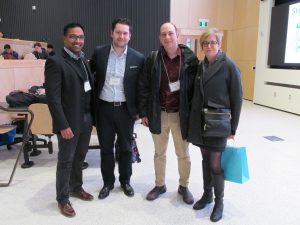
L-R: Drs. Rohin Iyer vs Brian Ballios with Jeremy Sivak and Valerie Wallace.
Drs. Valerie Wallace and Dr. Jeremy Sivak from the Krembil Research Institute and University of Toronto talked about the pros and cons of taking a standard care approach or using new experimental therapies for the treatment of macular degeneration and other blindness-related diseases. The take home message was future treatments will be a combination of gene therapy and drug therapy to slow down the progression of degenerative eye diseases.
Next, Dr. Iyer debated the use of allogeneic (donor) cells in cell therapy, while his opponent, Dr. Brian Ballios, a Resident Physician in Ophthalmology at the University of Toronto, argued for the use of autologous cells – cells derived from the patients themselves. They highlighted the current challenges of getting stem cell-based therapies into the clinic and each presented strong arguments; however, in a show of hands, it was clear the students were in favour of Dr. Iyer’s allogeneic approach.
Keynote speaker Dr. Jeffrey Harding, a Postdoctoral Fellow at the Lunenfeld Tenanbaum Research Institute, introduced the concept of stem cell cloaking for bypassing immune-rejection in patients receiving stem cell transplants.
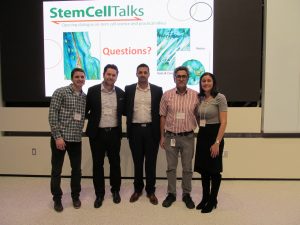
L-R: The expert panel with Drs. Jeffrey Harding (moderator), Brian Ballios, Chris Ahuja, Mohammad Massumi and Sarah Wassmer.
Dr. Harding also moderated the ethics discussion on the manufacturing and feasibility of stem cell based therapies for retinal stem cells. Students asked questions directly to the panel of experts: Drs. Brian Ballios, Chris Ahuja, a Neurosurgery Resident at the University of Toronto, Mohammad Massumi, a Senior Postdoctoral Fellow in Andras Nagy’s lab and Sarah Wassmer. The group highlighted exciting trends in stem cell science, such as the recent US-FDA approval of Luxturna, a gene therapy for Leber’s Congenital Amaurosis, and Kymriah, an engineered cell therapy for patients with acute lymphoblastic leukemia and diffuse large B-cell lymphoma. Overall, the group was very optimistic about the current advancements in the field and how they are providing a platform for new gene and cell therapeutics to treat human disease.
Attending my first StemCellTalks made for a memorable experience. I was impressed by the bright group of high school students and the knowledge I gained about retinal stem cell therapy—if only such a program existed when I was in high school. Congratulations to the graduate student volunteers for organizing a successful StemCellTalks 2019!

Guest
Latest posts by Guest (see all)
- Regenerative immunotherapy: Hope for chronic autoimmune diseases - September 16, 2025
- Canada’s regenerative revolution: Why AI is the catalyst - September 4, 2025
- Summer by Design: A launchpad for future entrepreneurs and industry scientists - August 14, 2025


Comments