

 .
.
It’s probably safe to say that we all have some sort of genetic risk factor that runs in our families. For some its diabetes. For others it’s heart disease. For my family, it is mild hearing loss. In trying to make light of this, I sometimes tell myself, “Well, hey, at least when your mental functions start to decline you won’t hear anyone complain about it.” Kidding aside, hearing disorders can actually be devastating, and they are not at all uncommon.
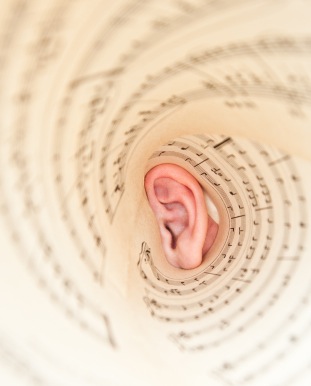
Even for those of us who could hear a fly sneeze two rooms over, it’s worth taking a moment to appreciate the amazing complexity of audition.
While most of us think of the external, or visible ear, when we think of hearing, where the magic really happens is in a tiny structure called the cochlea buried deep within our skull. (In fact, this is why cochlear implants are often called “bionic ears”.) Within the cochlea and surrounded by fluid channels, there is a membrane that supports hair cells. Just as a raft will move up and down in response to waves in a lake, this membrane will respond to fluid pressure waves initiated from incoming sound. The hair cells on this membrane then bend and send neural signals to our brain where we interpret this information. Different pitches activate different hair cells, and this whole structure has the ability to adapt to emphasize important stimuli. (Here’s a video of the process of hearing.)
If this seems hard to imagine, it’s even harder to re-create from stem cells in the lab.
Specifically, trying to re-create the phenomenon of “mechanotransduction”, where hair cells convert mechanical vibrations into electrical signals, is incredibly challenging. Yet a group at Indiana University School of Medicine has brought us closer to such an achievement, which is described in this month’s issue of Nature.
By using a 3D culture environment and very precisely timed exposure to important developmental signals, they were able to direct the differentiation of mouse embryonic stem cells to inner ear precursor cells, which then differentiated into structures critical to the inner ear such as hair cells. Not only were they able to show that these hair cells were functional using electrophysiology, but neurons also developed in culture and formed synapses with these hair cells, which is what needs to happen to send signals to the brain.
The ability to re-create hair cell mechanotransduction opens doors to creating models of disease for both hearing and balance disorders (the vestibule, which controls balance, is also in the inner ear and functions similar to the cochlea). While technologies such as hearing aids and cochlear implants exist, they are expensive, and it would be helpful to learn more about the mechanisms underlying hearing dysfunction so as to be able to prevent it. Furthermore, if an adequate in vitro model were developed, then candidate drugs could be tested on such a system.
Clinical applications aside, I cannot help but be slightly inspired by this work as a fellow stem cell researcher. Sometimes, when presented with a challenging goal (as I imagine recreating the inner ear to be), the natural reaction can be for one’s eyes to glaze over, stomach to drop, and brain capacity to suddenly feel completely absent, save for the single, overwhelming thought, “How am I going to do that?” To see fellow scientists striving for and succeeding in modeling complex biological systems is a reminder to me (and to all of us) to not limit our questions, but to continue to strive for answers that may not come easily but will be of utmost importance. Hopefully, we’ll all be able to hear about stories like this for decades to come.
Research cited:
Koehler K.R., Mikosz A.M., Molosh A.I., Patel D. & Hashino E. (2013). Generation of inner ear sensory epithelia from pluripotent stem cells in 3D culture, Nature, DOI: 10.1038/nature12298
Schwander M., Kachar B. & Muller U. (2010). Review series: The cell biology of hearing, The Journal of Cell Biology, 190 (1) 9-20. DOI: 10.1083/jcb.201001138


Holly Wobma
Latest posts by Holly Wobma (see all)
- Relay race to finish off inflammatory cells - July 12, 2017
- What time zone is your heart tissue In? - June 19, 2017
- Filling the void: A scientist’s introduction to commercialization/clinical translation - April 26, 2017



Trackbacks/Pingbacks